Get Full Government Meeting Transcripts, Videos, & Alerts Forever!
Get email alerts on the Radio System topic
No spam. Unsubscribe anytime.
Ulster County hears progress report on 16‑site radio replacement and backhaul plan
Summary
County consultants briefed the Public Works Committee on an evolved 16‑site radio design intended to close coverage gaps across populated corridors, described microwave backhaul redundancy that leverages neighboring counties’ infrastructure, and said the system targets a Q3 2028 go‑live with phased deployment and substantial grant support.
Chair Nolan opened the committee’s June 8 session and described the meeting’s presentations, then Director Ericson introduced Neistac project manager Chris Carney to brief members on the county’s radio replacement program.
Chris Carney, project manager with Neistac, said the original Motorola contract (signed in 2019–20) envisioned an expansion of the county’s emergency radio system but that the design has evolved substantially. “We went from five sites to 16 for fire and EMS, and 16 sites for police and paging,” Carney said, summarizing work to date and the reason for the redesign: fill coverage gaps in population centers rather than maximize land area coverage.
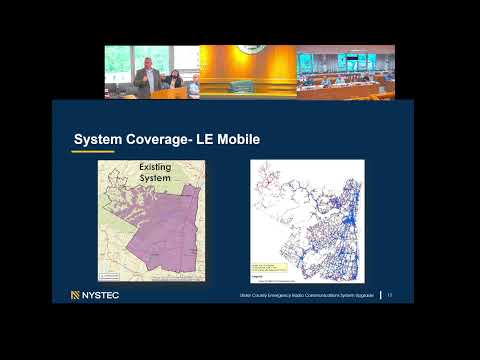
Carney showed maps created from three to five years of CAD/911 call data that identify incident hot spots in Kingston, the Route 209 corridor and other populated routes. He said the new dark‑blue overlays on the maps represent coverage the evolved design would add, improving portable (on‑person) and mobile coverage in previously underserved areas such as Ellenville and parts of the Catskills.
A significant portion of the presentation focused on backhaul: the microwave network that will synchronously interconnect 16 transmitters so the system can operate as a simulcast. Carney described single points of failure in the existing network (for example, losing the Kingston→Sam’s Point link would also knock out Illinois Mountain and a state police backup site) and said the county’s plan is to build redundancy by riding microwave systems in neighboring counties where terrain makes self‑contained routing difficult.
Funding and schedule were the other major topics. Carney said the county secured FCC frequency authorizations and that the state issued roughly $3 million in grant funding to advance the project. Staff briefed legislators that about $12.7 million in grant awards are already in hand, that awards expected to be executed will raise that total toward $15.18 million, and that the capital project currently shows roughly $36 million in county plan funding. The county estimates the total project cost at about $50.7 million; staff said they aim to keep pursuing grant funds to offset county costs.
On timing, Carney said Motorola’s contract requires full‑foliage coverage testing (June 1–Sept 30) so coverage tests are worst‑case (leaves on trees absorb radio energy). That testing window, combined with the volume of drive‑testing required, puts the realistic target for a full go‑live in the third quarter of 2028 while staff pursue opportunities to accelerate parts of the rollout.
Committee members asked about immediate benefits, whether towers will host cellular carriers, and life‑cycle maintenance. Carney and staff said the county is already adding paging sites in some towns, new towers are being designed to accept carrier equipment (subject to municipal approval), and county‑owned equipment will have planned refresh cycles roughly every three to five years with a goal of stretching useful life across two decades.
What’s next: staff said they will continue grant applications and expect phased construction and testing notices before implementation begins. The committee did not vote on this item; the presentation served as a project update and opportunity for legislators to press for municipal carrier attachments, asset lifecycle budgeting and site‑specific permitting clarifications.