Get email alerts on the Emergency Alerts topic
No spam. Unsubscribe anytime.
Paradise accepts FEMA‑funded siren system and sets initial maintenance fund; monthly tests will continue
Summary
Council accepted the FEMA/HCD emergency warning system closeout and directed staff to set aside $15,000 for FY26 maintenance under a time‑and‑materials plan; staff will continue monthly noon tests and monitor system performance.
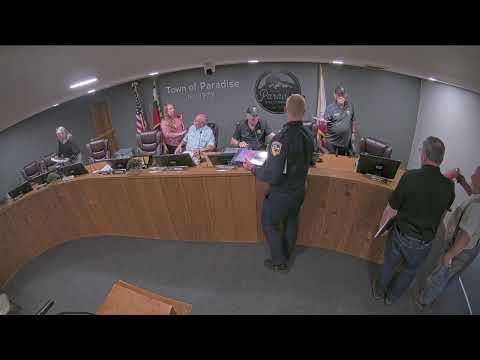
The Paradise Town Council unanimously accepted the closeout report for the town’s FEMA‑ and HCD‑funded emergency warning siren project and provided direction on initial maintenance funding on Thursday.
The project, constructed with federal hazard mitigation funds and HCD match and completed under budget at about $2.74 million, includes 21 towers and community “safe unit” receivers. Staff said the system has been fully operational for nearly two years and that monthly tests on the 15th of each month serve both public familiarity and dispatcher training.
Council action: Council accepted the project closeout and directed staff to fund maintenance under a time‑and‑materials approach while setting aside $15,000 in the next fiscal year to satisfy ongoing maintenance expectations in the original grant agreement. The council also directed staff to continue audible monthly tests (the 15th at noon) and to return with longer‑term maintenance options after a period of observation.
Why this matters: The system is intended to be a durable, town‑wide last‑resort alert tool; staff noted batteries and some electronics will require periodic replacement (batteries estimated to be replaced every 5–7 years) and that long‑term repair and software support will be necessary. The grant required the town to plan for minimum annual maintenance funds; staff recommended $15,000 as a prudent initial set‑aside to cover diagnostics and limited field visits.
Representative quote: “The system has been fully operational now for almost two years,” project manager Brian Selei said. “We finished the project under budget. The equipment is robust, and the primary recurring cost will be periodic maintenance and battery replacement.”
Public testing and outreach: Council discussed the frequency of audible testing after some residents asked for fewer loud monthly tests. Staff said the system also supports offline dispatcher training and silent diagnostics; several council members favored continuing the monthly tests because they keep the public and dispatch readiness high.
Next steps: Staff will monitor system reliability over the coming year, track actual maintenance costs, and return with a recommended, longer‑term maintenance contract or options for council consideration.
AI generated
The text on this page is AI generated. Summaries, highlights, analysis, and video transcripts are all produced from the original source material.
AI can make mistakes, so if you spot one, and we will fix it for everyone.
Note: the source content is unaltered by us. Any content source we link to, be it a video, an audio recording, or a document, is presented exactly as its publisher released it. That publisher is usually a government body, sometimes an individual official or another organisation.