Get Full Government Meeting Transcripts, Videos, & Alerts Forever!
Get email alerts on the Public Art topic
No spam. Unsubscribe anytime.
Committee advances mural-notice ordinance after artists and residents recount sudden removals
Summary
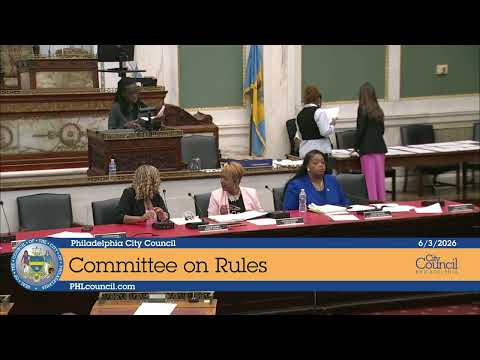
The City Council Rules Committee advanced Bill 260381, a measure requiring permit applicants to notify the Department of Licenses and Inspections when properties host murals, after extensive testimony from Mural Arts, muralists, residents and developers about unexpected mural removals and preservation agreements.
The Committee on Rules voted to report Bill 260381, a proposed amendment to the Philadelphia zoning code that would require certain permit applicants to notify the Department of Licenses and Inspections (L&I) when a property contains a mural, after a lengthy public record from artists, residents and developers.
Proponents framed the measure as a limited notice and stewardship tool, not a development ban. Jane Golden, founder of Mural Arts Philadelphia, told the committee the ordinance would create “a basic notice process between city departments and Mural Arts so that there’s an opportunity to communicate, to document and hopefully preserve or replace important works of art.”
Paula Brumblo Burns, director of legislation for the Philadelphia City Planning Commission, testified that the bill would add a new code provision requiring permit applicants to disclose the presence of murals to L&I. PCPC recommended holding the legislation for additional review but acknowledged the administration’s ongoing discussions about implementation.
Artists and community members gave detailed examples of murals removed or covered without advance notice. Aminata Sandre Calhoun said she returned from a trip to find the Ed Bradley mural fenced off and removed “with no warning,” and described the removal as a loss to community mental health and cultural memory. Muralist Eric Oak and painter David Gwyn said projects that took months or years of community collaboration have been lost to development that proceeded without prior notice.
Developers and owners who testified described efforts to protect murals through enforceable easements and agreements. Ryan Spack, principal at Spack Group, described contractual easements tied to property title and said his firm worked with Mural Arts to ensure murals are maintained or relocated when properties change hands. “This legislation is a start of an awesome conversation around public art,” he said.
Council members who commented framed the bill as an attempt to preserve cultural assets while allowing development to proceed. Council Member Gothier recounted a case in which a developer tied a variance approval to mural preservation, saying more time and notice would have avoided that coercive outcome.
What happens next: The committee adopted a motion reporting multiple bills with a favorable recommendation; Bill 260381 was included in the package to be read at the next council session. Committee members and administration staff signaled there will be follow-up on implementation mechanics, including the required notice procedure and any administrative paperwork L&I would use.
The hearing record shows broad support from artists, preservation groups and some developers for a notice-based approach; remaining questions center on how the notice will be operationalized and whether additional protections (easements, funding for relocation/preservation) should accompany the requirement.