Get Full Government Meeting Transcripts, Videos, & Alerts Forever!
Get email alerts on the Tree Preservation topic
No spam. Unsubscribe anytime.
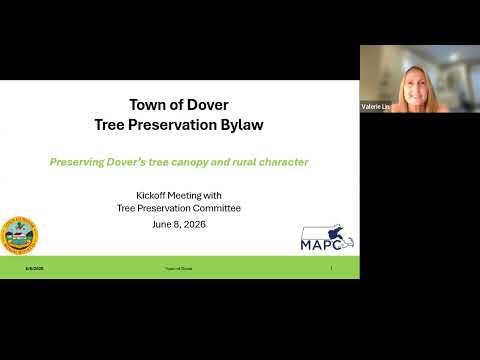
Dover committee and MAPC seek public input on proposed tree-preservation bylaw
Summary
The Dover Tree Preservation Committee and consultants from the Metropolitan Area Planning Council presented research, polled a small group of attendees and collected public feedback during an online community meeting about a potential tree-preservation bylaw. Attendees cited development-related clear‑cutting and equity concerns; the project will launch a July survey and aims to publish a draft bylaw this fall.
The Dover Tree Preservation Committee and consultants from the Metropolitan Area Planning Council (MAPC) held an online community meeting to solicit feedback on a potential tree‑preservation bylaw, presenting local regulatory gaps, best‑practice options and live poll results.
Valerie Lynn, chairperson of the Dover Tree Preservation Committee, opened the session by urging residents to share concerns and questions as the committee explores how to “preserve our beautiful tree canopy.” MAPC planners outlined three focus areas for a bylaw: defining what trees and places should be protected, establishing protection measures during construction and setting mitigation or replacement requirements when removal is unavoidable.
The presentation reviewed five existing Dover regulations that affect trees — the stormwater/erosion control bylaw, wetland protection bylaw, subdivision regulations, scenic‑road provisions and the groundwater protection district — and noted that protections vary by jurisdictional area and often leave much private lot acreage beyond review. MAPC said triggers for review could include building permits, major grading and substantial additions, and that a bylaw can combine size‑based definitions with species or habitat priorities.
In two live polls, attendees reported recent local tree loss and expressed guarded support for a bylaw. An initial poll (9 respondents) found that seven people had observed significant tree removal in their neighborhood in the past five years. In a subsequent poll of 10 respondents, about 60% said they strongly support adopting a tree‑preservation bylaw, roughly 30% were neutral and about 10% strongly opposed. MAPC emphasized the polls represent a small sample of meeting attendees and are only one early input stream.
Speakers and residents raised several recurring concerns. Some participants said developers frequently clear lots before construction, changing neighborhood character; Kathleen Weatherby said many lots near her have been “absolutely clear‑cut” after sale to developers. Several commenters urged that any bylaw avoid imposing undue costs on homeowners, particularly seniors or lower‑income residents, and discussed hardship or exemption paths. Jonathan Frier and others questioned whether town‑owned or conservation lands should be subject to the same rules; conservation commission representatives said those lands are typically managed under other protections but agreed the committee should consider applicability.
MAPC and committee members discussed practical components the town could adopt: an inventory of significant or historic trees, critical root‑zone protections, construction fencing, professional oversight for complex projects and mitigation options such as on‑site replanting, off‑site plantings in tree‑poor neighborhoods or contributions to a municipal tree fund. Diana Marsh of MAPC described a three‑tier approach — preserve, protect and mitigate — and noted some communities allow streamlined staff review for simple projects while reserving hearings for larger proposals.
Local arborist Jay Crocker pointed to an enforcement model he’s seen in nearby towns: “They have a tree bylaw that is enforceable and they do enforce it,” he said, recounting a job where a tree warden checked a contractor’s work mid‑job to prevent damage to a live tree. That example framed part of the discussion about whether Dover should add stronger enforcement mechanisms.
Officials closed by laying out next steps: the project team will launch a communitywide survey in July, continue research over the summer and aim to share a draft tree‑preservation bylaw at a second community meeting in September. The committee also said it will post summer meeting dates to the town calendar; the next Tree Committee meeting was announced for Wednesday, July 1 at 7 p.m.
No formal motions or votes were taken at the meeting; committee members framed the session as an information‑gathering and listening event. The project team asked residents to submit further feedback through the project website and invited those interested in committee service to contact the chair.