Get Full Government Meeting Transcripts, Videos, & Alerts Forever!
Get email alerts on the Commemoration topic
No spam. Unsubscribe anytime.
Scituate marks 110th anniversary of the Easter Rising with monument commemoration and keynote history talk
Summary
Scituate held a public commemoration on Feb. 24, 2026, marking the 110th anniversary of the 1916 Easter Rising with speeches by local officials and visiting founders of the National Famine Museum and National Famine Way, a keynote history presentation, and an invitation to view a privately funded monument in Scituate Harbor.
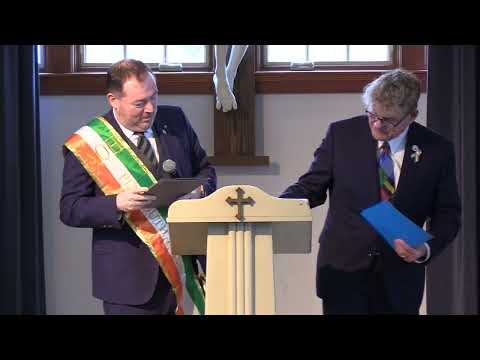
Scituate honored the 110th anniversary of the 1916 Easter Rising on Feb. 24, 2026, at a public ceremony in Scituate Harbor that included readings, guest remarks and a keynote history talk. The event highlighted the town’s long Irish‑American ties and the role of grassroots preservation efforts.
The program opened with music and remarks before Mike, introduced as president of the Father John Murphy Division of the Ancient Order of Hibernians, welcomed attendees and said the Easter Rising Monument in Scituate Harbor was funded entirely by private contributions and placed in a prominent town location. “This did not happen by accident. It happened because people cared,” Mike said, characterizing the monument as the result of local fundraising and community dedication.
Select Board member James Gilmore offered a town greeting, asked the crowd to observe a moment of silence for a recently deceased friend and reviewed Scituate’s Irish immigrant history. Gilmore noted Scituate’s “distinction of being one of the only cities or towns in America that flies the tricolor in honor of the Easter Rising,” and read local historical highlights backing the ceremony’s significance.
Visitors Jim and Carolyn Callerie, identified at the event as founders of the National Famine Museum and the National Famine Way, spoke about their work preserving famine history and making that history visible to diaspora communities. Carolyn Callerie described the National Famine Way as a walking heritage trail that is expanding internationally and said a U.S. pilot of the project uses pairs of small bronze shoes as markers; she announced that a pair of bronze shoes has been approved for Cohasset as part of the project rollout.
Keynote speaker Dave Holden delivered an extended talk tracing Irish and Irish‑American political history from the 18th century through the 1916 Rising. Holden recounted episodes including the Society of United Irishmen (founded 1791), the rebellions of 1798 and 1803, the Great Famine (1845–1852), Fenian activism in the 19th century, and the planning and execution of the 1916 Rising. He described the capture and destruction of an arms shipment intended for the Rising and quoted Thomas J. Clarke: “All of us that are going out tonight believe that we have saved the soul of Ireland,” which Holden offered to emphasize the Rising’s long historical resonance.
Organizers used the event to spotlight local preservation efforts and partnerships, including the Southshore Irish Heritage Trail and Strokestown Park’s programming. Sponsors named during closing remarks included Coastal Heritage Bank, UMass Boston, the Southshore Chamber of Commerce and local businesses; attendees were invited to visit the Easter Rising monument in Scituate Harbor and speak with the visiting guests.
The ceremony closed with invitations to continue the conversation at the monument and to join organizers for refreshments and informal Q&A with the speakers. A member of the audience then thanked St. Mary’s of the Nativity Parish and named clergy and volunteers for supporting the event venue.