Get Full Government Meeting Transcripts, Videos, & Alerts Forever!
Get email alerts on the Infrastructure topic
No spam. Unsubscribe anytime.
Commissioners press staff on seawalls, stormwater and a $125M neighborhood resiliency estimate
Summary
Public‑works staff presented CIP rankings and long‑range resiliency costs; commissioners prioritized immediate repairs and questioned phased seawall upgrades, FEMA/insurance reimbursements, and whether the city should pursue or defer large resiliency work pending engineering studies.
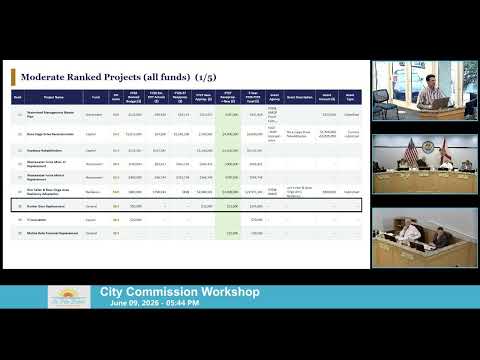
Camden Mills, the city’s public services director, walked the commission through the capital improvement program scoring process and the current ranked project list.
Mills said projects were evaluated on 10 criteria for a 100‑point total; projects scoring 60+ were categorized as high priority. Top items included wastewater collection improvements, stormwater system replacements, shoreline protection (city seawalls) and longer‑range resiliency/adaptation projects. Mills noted some projects are reappropriations of current year funds, others are new FY27 requests, and some have grant or insurance offsets (where awarded or applied for).
Commission discussion focused heavily on shoreline protection and stormwater resiliency. Mills referenced a prior seawall master plan that identified roughly $8.5 million of city‑owned seaw‑wall repairs and broader resiliency adaptation planning with multi‑decade, planning‑level costs cited in the packet (staff cited planning‑level totals in the tens of millions, and participants mentioned a $98 million resiliency figure in the record for broader adaptation work). Commissioners raised three recurring concerns:
• Phased upgrades vs. comprehensive approach: several commissioners worried that raising only some seawalls could create “funneling” or localized drainage issues and asked whether repairs should be limited to restoring existing condition rather than immediately raising elevation to a new code. Staff said the cost and structural need are case by case; adding modest caps to an otherwise sound bulkhead can be relatively inexpensive, but full replacements or sheet‑pile solutions are costlier.
• Grants, FEMA and insurance timing: commissioners pressed staff to clarify which projects already have awarded grant or insurance funding and which are only applications. Mills said some projects (for example, certain pump‑station work) have confirmed awards; many FEMA and insurance reimbursements remain subject to multi‑year reimbursement timetables and some grant applications are under review.
• Wastewater force main timing and procurement: the commission asked whether the proposed subaqueous force main (planning figures in the packet ran into multi‑year, multi‑million estimates) should proceed this fiscal year or be paused while the city explores county takeover/partnership options. Staff said procurement steps could be paused, that current FY27 line items would mainly fund procurement and planning, and that progressive design‑build approaches can include off‑ramps if partners or strategy shift.
Mills said staff will refine project descriptions, show which costs are likely reimbursable or grant‑eligible, and work to present clearer phasing and cost estimates at future sessions so commissioners can prioritize a smaller set of FY27 commitments.
Ending — next steps: staff will provide more detailed project‑level cost breakdowns, grant/insurance status and clearer recommended sequencing (including options for holding or accelerating projects depending on reimbursement timing and engineering study results).