Get Full Government Meeting Transcripts, Videos, & Alerts Forever!
Get email alerts on the Zoning Policy topic
No spam. Unsubscribe anytime.
Will County Land Use Committee advances CRGA-driven zoning text changes but delays contiguity decisions
Summary
County counsel presented draft text amendments to align Will County ordinances with the Clean and Reliable Grid Act. The committee approved sending the CRGA-focused edits to public hearing but asked staff to research whether non-contiguous parcels should be treated differently for fee and permit purposes.
Will County officials recommended narrowly scoped text amendments Thursday to bring county land-use rules into compliance with the Clean and Reliable Grid Act (CRGA), and the Land Use Committee agreed to send the changes to public hearing while reserving additional work on how the code defines a —facility.'
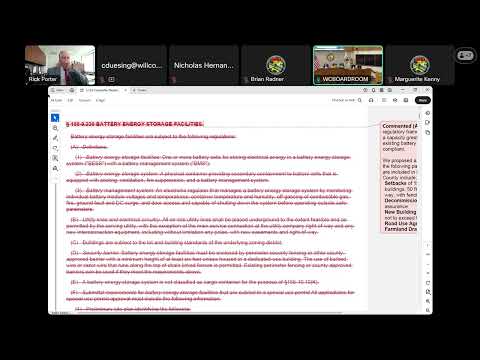
Attorney Rick Porter, who assisted in drafting the proposed ordinance language, told the committee the CRGA amended multiple state statutes to address wind, solar and battery energy storage facilities and includes new procedural steps that local ordinances must reflect. "This is designed to be compliant with state law," Porter said, explaining the purpose of the redlined draft and noting a recent amendment on the governor's desk clarifies an applicant's path to the Illinois Commerce Commission if a county lacks a compliant ordinance.
Committee members sought clarity on whether counties still retain discretion over special-use decisions. Porter said the statutes preserve local public hearings and many application submittal standards, but he acknowledged appellate courts disagree about how much substantive discretion counties can exercise and said the state Supreme Court could settle that divide.
A principal point of debate concerned the statutory fee limits and the definition of a facility. The CRGA sets presumptive fee caps (for example, a cap tied to megawatt nameplate capacity up to statutory maxima). Several members asked whether a county could require separate permits for non-contiguous parcels so that large multi-parcel projects could not consolidate for a single lower fee. Porter warned that treating each turbine or parcel as a separate facility may be vulnerable on appeal; he recommended the county adopt the CRGA-required language now and pursue text amendments on contiguity with the county's state's attorney.
Staff noted a final, narrow edit to add energy-storage systems to the county's 155-16.4 (county-board action) language so the 30-day county decision window would explicitly apply to energy-storage approvals as well as wind and solar.
Committee members agreed to forward the CRGA-compliant draft to public hearing and directed staff to return with options on the contiguity and fee-definition questions before adopting additional, broader changes.
The committee emphasized the need to meet the statutory timetable; county staff said the CRGA changes should be adopted before the September county-board meeting to avoid creating a statutory route to the ICC for applicants.
What happens next: staff will post the redlined language for public hearing, continue outreach and consult the state's attorney about how to draft provisions that protect local interests while minimizing litigation risk.