Get Full Government Meeting Transcripts, Videos, & Alerts Forever!
Get email alerts on the Public Safety Funding topic
No spam. Unsubscribe anytime.
Spokane County sheriff urges board to qualify for state public-safety grants and keep 0.1% sales-tax option amid $30M shortfall
Summary
Sheriff Gonol told the Spokane County Board of County Commissioners the county is ready to submit an application to qualify for a 2025 state public-safety grant program and the option to levy a 0.1% local sales tax, saying the move preserves choices as the county faces a roughly $30 million projected deficit for 2027 and possible deep staffing cuts.
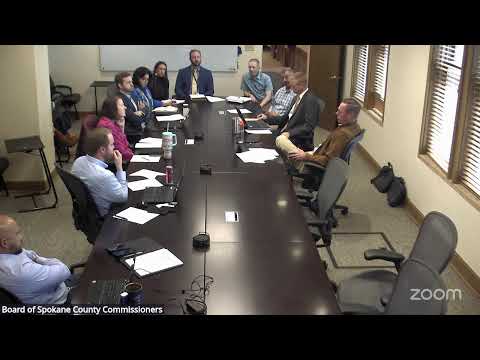
Sheriff John Gonol urged the Spokane County Board of County Commissioners on June 9 to authorize submitting an application that would qualify the county to apply for 2025 state public-safety grant funding and for the statutory onetenth (0.1%) public-safety sales-tax option.
Gonol said Spokane County has already begun reporting use-of-force and CAD data to the Washington data exchange (WEPS/WADUS) and that county policies have been revised to match the attorney general’s model policies so the county is prepared to be considered eligible. “I want to be very clear: the sheriff’s office doesn't have the ability to apply for that. It has to be Spokane County who submits the application,” he said.
The grant and tax were created in 2025 legislation Gonol described as providing both a competitive grant program and a new local taxing authority. Gonol told commissioners the state grant program typically will fund about 75% of an approved full-time equivalent (FTE) for three years, with a capped per-FTE amount, and that federal hiring programs (COPS grants) may be a more stable source to add officers.
Why it matters: County staff estimated a full-year onetenth tax would bring in roughly $17 million (about $14.3–$14.5 million pro-rated in a first partial year), while the county is facing approximately a $30 million budget deficit for 2027. Gonol warned that a across-the-board reduction to meet the shortfall could eliminate “anywhere from 27 to some estimates as high as 40 plus FTEs” paid by the county in unincorporated Spokane County, removing school resource deputies, traffic deputies and most county-funded property-crimes investigators and increasing response times.
Commissioners asked about supplanting rules and whether grant funds could be used for current operations such as the real-time crime center (RTCC). Gonol said grant funds cannot be used to supplant existing positions and that the grant’s 75% FTE funding and three-year limit mean the county would need to provide a local match and plan for long-term costs. He added the grant can fund equipment, treatment programs and some emergency-management functions beyond sworn positions, depending on CJTC and grant priorities.
The application process: Gonol described a review period in which the Criminal Justice Training Commission (CJTC) and the attorney general’s office compare county policies against model policies; the county would then have a roughly 180-day window (90 days review plus 90 days to remedy discrepancies) to address issues before the Department of Revenue could withhold funds. Gonol said the application would be presented again at the board’s 2 p.m. meeting to enable submission and stressed that qualifying now preserves the board’s choices later.
Political and procedural choices: Staff and counsel told commissioners the statute allows the county to implement the tax by ordinance or, in some circumstances, by resolution (a so-called councilmatic action) without a public vote until June 30, 2028; after that date imposition would require a ballot measure. Effective start dates are limited to January 1, April 1 or July 1, and a January 1 start generally requires ordinance posting and a roughly 75-day lead time.
What’s next: The sheriff asked the board to submit the attestation and application to secure eligibility so the county has the full set of options — grant awards, federal hiring programs and the local onetenth tax — available as the board crafts its 2027 budget. The board planned to revisit the matter at its 2:00 p.m. legislative session for any formal authorization.