Get Full Government Meeting Transcripts, Videos, & Alerts Forever!
Get email alerts on the Public Safety Enforcement topic
No spam. Unsubscribe anytime.
Whitefish Bay board adopts ordinance allowing police to impound vehicles used in reckless driving
Summary
On Jan. 5 the Whitefish Bay Village Board voted to adopt Ordinance 1922, exercising authority under 2025 Wisconsin Act 46 to allow police to tow and impound vehicles used in the commission of reckless driving. Trustees raised questions about vagueness; the chief said the law adds a tool but does not change the statutory definition.
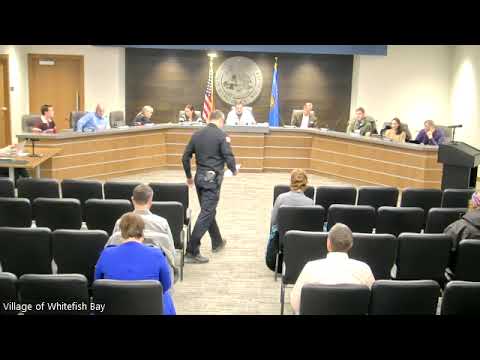
The Whitefish Bay Village Board voted Jan. 5 to adopt Ordinance 1922, authorizing the police department to tow and impound vehicles used in the commission of reckless driving under 2025 Wisconsin Act 46. The measure was approved by voice vote; the transcript records the board members saying “I,” and did not record individual roll-call tallies.
The police chief urged adoption, saying the state act gives localities a new enforcement tool to remove vehicles used in dangerous driving that threatens motorists and pedestrians. “This act amends Wisconsin state statutes to allow law enforcement officers to tow and impound vehicles used in the commission of reckless driving if the local political subdivision adopts an ordinance,” the chief said. He added the ordinance “doesn’t change the definition of reckless driving or how we would enforce it. That just gives us the opportunity to tow and impound vehicles used during the commission of reckless driving.”
Board members asked for clarification about scope and wording. Trustees expressed concern the ordinance language could be broad or vague and asked whether the change would alter the legal definition of reckless driving. The chief and the village attorney responded that the ordinance adds the impoundment remedy without changing the statutory definition; they cited the statutory negligence standard that requires conduct creating a substantial and unreasonable risk of death or great bodily harm, and noted the tool would not be used for routine speeding infractions.
Officials also discussed local context and logistics. The chief said nearby municipalities have adopted or are moving toward similar ordinances. He provided recent local incident counts for context: two reckless-driving cases in 2021, 11 in 2022, six in 2023, six in 2024, and four in 2025. Trustees asked where towed vehicles would be stored and how disposition would work; the chief said routine towing companies (for example, Leader Towing) handle storage and disposition under state statute and that storage fees would normally be paid by the vehicle owner.
A trustee moved to adopt Ordinance 1922; another trustee seconded, and the board approved the ordinance by voice vote. The transcript did not identify the mover by name or record individual votes by member.
After adopting the ordinance the board moved into a closed session to discuss negotiations and property matters, including a developer agreement related to 511 North Lydell and Whitefish Bay School District use of parkland. The meeting later returned to open session and adjourned.
What’s next: The ordinance takes effect according to the municipal code and applicable state statute; the board did not record additional implementation steps in the open session discussion.