Get Full Government Meeting Transcripts, Videos, & Alerts Forever!
Get email alerts on the Library topic
No spam. Unsubscribe anytime.
Whitefish Bay library lays out 2026–30 strategic plan, seeks more staff and facility upgrades
Summary
Library staff told the Village Board on April 6 that very high use has left the Whitefish Bay Public Library understaffed and in need of more study rooms, improved staff workspace and accessibility upgrades; the board discussed funding routes and next steps toward a facilities pre-design and 2027 budget changes.
At the April 6 meeting of the Whitefish Bay Village Board, library staff presented a draft 2026–30 strategic plan that calls for additional full‑time positions, more study rooms and targeted facility upgrades to address heavy community use.
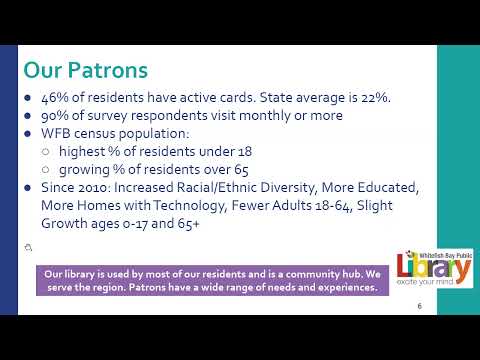
The library presentation, led by library staff and consultant Nikki Degair, emphasized the system’s unusually high demand: about 500 patrons per day in 2025 (roughly 11 visits per resident annually), 46% of residents hold active library cards (the state average is 22%), more than 300 programs with roughly 12,000 attendees, and 37% of circulation coming from non‑residents (up from 31% in 2024). Staff said the library circulates about 60% more materials per staff member than peer libraries, leaving current staffing stretched thin.
“Our greatest challenge is our success,” the library presenter said, explaining that the library’s 11 full‑time equivalent (FTE) positions fall short of a calculated target of about 17 FTEs that would match workload. The presenter said that shortfall concentrates most programming, collection development and service tasks on a few full‑time staff and is causing turnover among part‑time employees.
Why it matters: board members said the library is a high‑value regional resource and that staffing and modest facility investments would help sustain service. Staff proposed three priorities: (1) increase FTEs to match high usage (with the library aiming to convert some part‑time positions to full‑time during the 2027 budget process); (2) a facilities pre‑design study to evaluate adding study rooms, improving staff workspaces and adding a second‑floor public restroom; and (3) a financial plan that balances levy limits with foundation and Friends fundraising (Friends contributions have ranged from about $40,000 to $70,000 annually in recent years).
The presentation also highlighted rising costs for digital services: the Hoopla platform is popular because it eliminates hold times, but it is pay‑per‑use and increasingly expensive; Wisconsin state law was cited as a constraint that prevents charging patrons for subscription access. Staff recommended continuing to pursue diversified funding — including a spring and fall fundraising push by the Friends/Foundation — while advancing a modest facilities plan.
Board discussion touched on operational details: creating reservable study rooms, managing tutors who use library spaces extensively, the difficulty of hiring and retaining part‑time staff at 10–15 hours per week, and potential one‑time investments (for example, additional self‑checkout equipment or repurposing back‑office space) that could relieve staff burden. Staff noted a roughly $60,000 uncommitted balance in Fund 13 that could fund a pre‑design study and said smaller remodel items (under bid thresholds) can be managed with donated funds.
Next steps: staff will finalize a prioritized project list and return with cost estimates and a recommended timeline; board members indicated they expect staffing and facility items to be considered through the 2027 budget and CIP processes.