Get Full Government Meeting Transcripts, Videos, & Alerts Forever!
Get email alerts on the Municipal Finance topic
No spam. Unsubscribe anytime.
Whitefish Bay board adopts policy to raise unassigned fund balance to 40% after OPEB study
Summary
After an actuarial presentation showing a GASB 75 OPEB liability of roughly $5.5 million and about $2 million in related assets, the Whitefish Bay Village Board voted unanimously March 16 to amend its unassigned general fund balance policy to 40% to strengthen reserves and support credit rating goals.
Whitefish Bay’s village board voted March 16 to adopt Resolution 3197, amending the village’s unassigned general fund balance policy to 40% after an actuary’s presentation on retiree health liabilities.
Kelsey, a village staff member who introduced the item, told the board that “to increase from 35% to 40%, uh we would have to increase our unassigned fund balance um by $647,000,” and described a plan to use annual surpluses until the target is reached. The motion to adopt the policy passed on a voice vote with no recorded opposition.
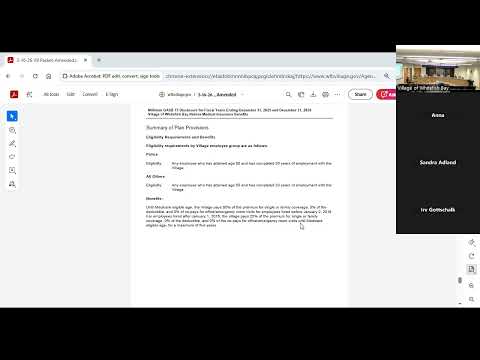
The vote followed a detailed presentation from Jack Schmelski, a principal and consulting actuary with Milliman, who summarized the village’s GASB 75 liabilities for retiree medical benefits (often referred to in practice as OPEB). Schmelski said the valuation shows a beginning liability of about $4.9 million that reconciled to roughly $5.5 million for the current measurement period, driven chiefly by an unanticipated medical premium spike and an increase in the implicit-subsidy factor used to convert premiums into expected claim costs. He noted the accounting liability differs from the village’s expected cash payments: “By that logic, we’re well funded for what we would pay,” Schmelski said, describing how GASB 75 uses a claim multiplier (about 2.18 for pre‑65 retirees in this report) that increases the reported liability relative to the village’s direct cash outlays.
Staff said the village holds about $2 million in assets designated for retiree medical benefits—roughly 40% of the GASB liability on a valuation basis—and that actual annual cash payments are expected to be materially lower than the $5.5 million accounting figure. The actuary explained the valuation uses GASB 75 rules and a discount rate tied to the 20‑year municipal bond index (4.08% on the earlier measurement date, 4.83% on the more recent one), meaning market rates materially affect the present‑value liability.
Trustees asked about peer practices, the interaction between fund‑balance policy and OPEB funding, and whether setting the policy at 40% (rather than 45–50%) was sufficient. Staff and the consultant said Moody’s and other rating agencies view a policy in the 35–50% range favorably and that simply having a written target is a positive signal ahead of planned debt issuance. Board discussion also noted the practical flexibility of keeping funds in the general account rather than in a trust: because the village has not placed the OPEB assets in an irrevocable trust, the board retains discretion to use the funds if needed.
Kelsey and finance staff told trustees they anticipate one‑time permit revenues and other year‑end factors could generate a multi‑hundred‑thousand‑dollar surplus this year; staff estimated a possible surplus near $1.5 million (final numbers to be confirmed after closing the books), part of which could be assigned to reach the 40% target without new borrowing.
The board adopted Resolution 3197 by voice vote; no board member recorded opposition. The meeting then moved to adjournment.
Votes at a glance: Resolution 3197 — “A resolution amending a policy for the unassigned general fund balance of the Village of Whitefish Bay” — moved, seconded and adopted by voice vote (motion carried; no recorded opposition).