Get Full Government Meeting Transcripts, Videos, & Alerts Forever!
Get email alerts on the Land Use Development topic
No spam. Unsubscribe anytime.
Plan Commission approves conditional use permit for Argo at Fox Bay theater with parking, noise and security conditions
Summary
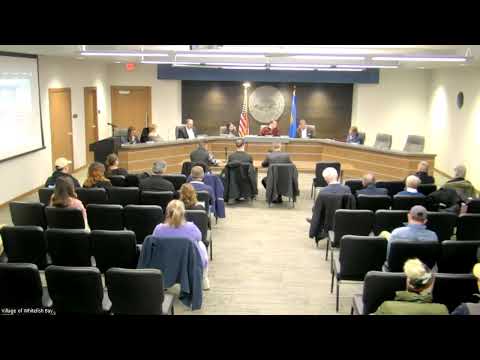
The Whitefish Bay Plan Commission approved a conditional use permit for the Argo live-entertainment venue at the former Fox Bay theater, subject to conditions on hours, a 750-person cap, noise monitoring (65 dB at property line), parking arrangements and an annual security plan; the approval moves the proposal to further village review.
The Whitefish Bay Plan Commission voted to approve a conditional use permit for the Argo, a proposed live-entertainment venue, bar, restaurant and event space at the former Fox Bay theater (334 East Silver Spring Drive), adopting staff recommendations with two commission amendments.
The permit allows a combined maximum occupancy of 750 people in the three proposed spaces (entertainment venue, event space, bar/restaurant) except for one annual, preapproved event if the applicant demonstrates adequate private off‑street parking. Staff recommended, and the applicant agreed to, operating hours that limit bar and restaurant guests to be out of the building by midnight and cap entertainment hours on Friday and Saturday at 11:00 p.m.; earlier weekday closing times were set for other uses. The commission amended the staff proposal to allow up to 20 outdoor seats (rather than 10) and to require no deliveries in the alley before 7:00 a.m.
Why it matters: The project repurposes a 1951-era theater into a mixed-use destination the applicant and many downtown property owners say will reinvigorate Silver Spring Drive. Neighbors have raised concerns about parking spillover, queuing, early-morning deliveries and noise; the commission and staff built enforceable conditions into the permit intended to manage those impacts before the project advances to the Community Development Authority and Village Board.
Key facts and conditions
- Decision: Plan Commission approved the conditional use permit as presented by staff and amended by the commission; motion carried by voice vote. - Capacity: The applicant and staff agreed there shall be no more than 750 guests in the building at any one time (employees excluded); a one-time annual exception above 750 requires written village-manager approval and proof of private parking for the excess attendees. - Hours: Staff and applicant agreed bar/restaurant patrons must be out by midnight; entertainment events are limited to 11 p.m. on Friday and Saturday (staff-recommended baseline for other days was 10 p.m.). Changes to hours would require an amendment to the CUP. - Parking and trip generation: A traffic/parking study prepared by Graef estimated a typical concert (≈500 attendees) would generate about 280 vehicle trips (assumes 1.8 people per vehicle) and a rare maximum event (750) about 420 trips. The study counted roughly 239 public spaces within a one-block radius and an additional ~360 public spaces within a larger secondary area (≈599 total); staff and the applicant plan to use shared parking agreements with private lots for peak events. - Noise: Staff recommended and the applicant agreed to hire a village‑approved third-party acoustical consultant to model and verify sound. The CUP includes a limit of 65 dB SPL at property lines and requires a pre-occupancy sound test and implementation of the consultant’s recommendations into building plans. - Security and enforcement: The applicant must submit a detailed security plan to the police chief for review and annual approval; failure to obtain or follow annual approval can trigger plan commission review and possible revocation. The applicant also agreed to reimburse the village for extraordinary security expenses tied to its operations (e.g., overtime for police at large events). - Operational requirements: Ticket-sale maximums will be submitted for administrative review; ticket sales numbers for events over 550 must be provided to the village 48 hours before the event; employee parking is required to be in private lots; bus and delivery vehicles must park off‑street when not actively loading/unloading.
What proponents and opponents said
Sheldon Oerman, CFO of Newland Enterprises (the building owner), told commissioners the owners vetted operators and are committed to being good neighbors: “we too understand the pressures of what happens when that thing we said was a good idea doesn't turn out to be a good idea,” and said the owner will work with tenants, neighbors and the village on mitigation.
Adam Powers, an Argo co-founder, emphasized outreach and mitigation steps: “we take those concerns … not taken lightly,” and described front-door queuing, interior sound treatment and community events as ways to integrate the venue with downtown activity.
Alex Modal, Graef’s traffic engineer, summarized the parking analysis and conservative assumptions used for trip generation and noted the study did not reduce demand for likely pedestrian, bicycle or transit trips in nicer weather.
Several residents applauded the redevelopment and urged the commission to preserve historic elements such as the Fox Bay marquee; others cautioned about parking on residential streets (Berkeley, Dersy) and potential bus and ride-share queueing conflicts on Silver Spring Drive. Phil Himlfarb, a Bowmont resident, said Bowmont residents had worked with the applicant and expressed support after negotiations.
Next steps and monitoring
Plan Commission approval is one step. The project still requires Community Development Authority and Village Board consideration, building permits, and a liquor license. Staff said the village will continue coordination with police and public works and that a post-opening review (one to three months after opening) is expected to assess actual parking, queuing and signage needs and to make adjustments where village authority allows.
The permit ties operational conditions to enforceable code provisions (Chapter 16 and related sections) and includes mechanisms (annual security-plan approval, pre-occupancy noise testing, ticket reporting and possible revocation) designed to provide recourse if the venue’s operations create public-safety or neighborhood problems.
Why the commission approved: Commissioners and staff said the applicants had sufficiently addressed key neighborhood concerns through the parking study, security commitments, noise‑monitoring plans and the enforceable CUP conditions, and the commission cited the project’s potential to bring economic and cultural activity to the downtown corridor.
What is not specified or remains to be resolved
- Exact post-opening signage and traffic control measures (staff and police will evaluate after opening and add/adjust signs as needed). - Formal shared‑parking agreements with private lot owners (applicant is pursuing agreements with Aurora and other lot owners; staff recommended conservatism when drafting parking credit). - Final ticketing/entrance flow details and the village’s administrative sign‑off steps tied to occupancy and building-permit reviews.
Ending
The commission’s vote moves the Argo proposal past a key regulatory hurdle; village staff and the applicant will continue coordination with police, public works and the CDA before the Village Board and final occupancy approvals.