Get Full Government Meeting Transcripts, Videos, & Alerts Forever!
Get email alerts on the Water Infrastructure topic
No spam. Unsubscribe anytime.
Whitefish Bay outlines year‑by‑year plan to replace lead service lines; 145 laterals targeted in first project
Summary
Staff presented a strategic plan to replace one mile of water main per year in Whitefish Bay, citing a 2025 inventory of about 4,800 service lines (2,494 confirmed lead, 1,537 suspected) and a proposed 2027 project that would replace 145 confirmed lead laterals.
Maxine Miller, the village staff engineer, told the Public Works Committee on Jan. 12 that Whitefish Bay has about 47 miles of water main, most of it close to the end of its expected life.
"We have almost 4,800 water service lines and of that amount 2,494 are confirmed lead and 1,537 are suspected," Miller said, describing the inventory the village submitted to residents and the Wisconsin Department of Natural Resources (DNR).
Why it matters: the village plans a staged program that replaces roughly one mile of main each year and pairs main work with private and public service‑line replacements to reduce future disruption. Staff said early‑year priorities will emphasize streets in good condition so crews do not tear up recently resurfaced roads.
Staff described a prioritization matrix that weights road condition heavily — roughly 85% of the score — and water‑system factors such as age, breaks per linear foot and material about 15%. Miller said that balance is deliberate for the program’s early years to avoid undoing recent street investments, but the criteria are a "living" set of data and will change if repeated breaks or other field evidence alter priorities.
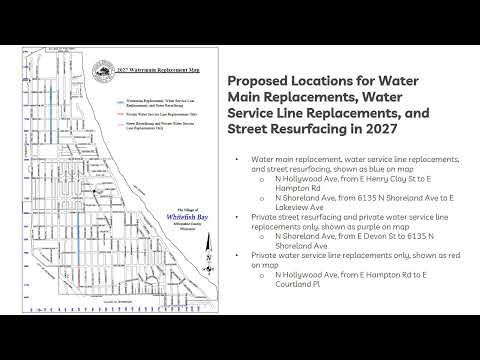
A proposed 2027 map shown to the committee identifies two primary stretches for combined water‑main, lead service‑line and resurfacing work, including a Hollywood Avenue section (Henry Clay to Hampton) and a Shoreland/6100‑block area. Staff said the 2027 package totals about 5,500 linear feet — slightly more than one mile — and includes 145 confirmed lateral replacements (66 in the Hollywood section and 79 in Shoreland).
Outreach and public health: Brooke, the Northshore Health Department case manager hired to lead community outreach, outlined a three‑tier outreach strategy that starts with the highest‑risk blocks and households with children under six. "Our key focus of the program is reducing barriers for our residents," she said, noting the outreach will combine on‑site visits, printed materials, online tools and help applying for financial assistance.
Brooke also told the committee that required state training for lead‑risk assessors was canceled by the Department of Health Services and could be delayed about three to six months — a disruption that affects some steps of the outreach and in‑home work.
Schedule and procurement: staff gave a timeline that calls for an engineering contract award in early February, completion of plan documents before Halloween 2026, public bidding around Dec. 14, 2026, a construction contract award in 2027 and construction starting in spring 2027.
Funding and regulatory context: Miller said the village applied in October to the DNR Safe Drinking Water Loan Program for project planning funds. She told the committee Whitefish Bay is not eligible for the DNR’s principal‑forgiveness program and that private side replacements are likely to rely on special assessments or low‑interest loan programs. Committee members and staff also discussed uncertainty about how the state will treat "suspected" lead service lines under the revised federal lead and copper rules and noted litigation and state rule‑making may affect final schedules and targets; staff said the LCRI compliance timeline currently points to 2028 for broader enforcement.
What’s next: staff will finalize an engineering scope, continue field verification of the lead service‑line inventory and refine outreach materials and GIS tools so residents can look up their address. The committee did not take formal action on the plan at the Jan. 12 meeting; staff called the presentation a "gear‑up" year to test processes and communications before construction begins.