Get Full Government Meeting Transcripts, Videos, & Alerts Forever!
Get email alerts on the Water Supply topic
No spam. Unsubscribe anytime.
Town staff outlines water-supply contingency plans as Colorado River cuts loom
Summary
A town staff presentation said Cave Creek could face at least a 20% reduction in CAP deliveries in 2027 and described short- and long-term measures including exchange agreements with Surprise and Peoria, municipal-well rehabilitation, a 2026 Phoenix interconnect, participation in a Verde River sediment study, and a 2023 ordinance to trigger shortage plans.
Cave Creek town staff told attendees that declining Colorado River reservoir levels threaten the town’s water deliveries and that local leaders are preparing a mix of short- and long-term responses. The presentation said the town “could experience at least a 20% reduction in its water allocation in 2027” and emphasized planning already underway to lessen impacts.
The update placed the local risk in a regional context, noting the Colorado River supplies about 40 million people, supports roughly 5.5 million acres of irrigated agriculture and moves water through seven states. Staff said Cave Creek receives about 95% of its municipal supply from the Central Arizona Project (CAP) and is therefore sensitive to reductions in CAP deliveries.
To bridge expected near-term cuts, staff described tentative water-exchange agreements with the cities of Surprise and Peoria that would trade stored CAP credits for delivered water via the CAP canal. Staff also said the utilities department is rehabilitating old municipal wells that could yield roughly 200 acre-feet per year while longer-term options are developed.
The town joined a Salt River Project-led Verde River reservoir sediment mitigation study as a non-voting participant; the study is examining whether enlarging Bartlett Lake Dam could add water to the SRP and CAP systems. Staff cautioned the project requires federal approval and that Cave Creek would likely pay millions of dollars for its share of construction costs if it proceeds.
Staff also described a due-diligence review of a proposed purchase from Harkah Valley LLC (west of Phoenix) that would have supplied about 500 acre-feet per year but was not pursued because of uncertain infrastructure and treatment costs. That option remains under future consideration.
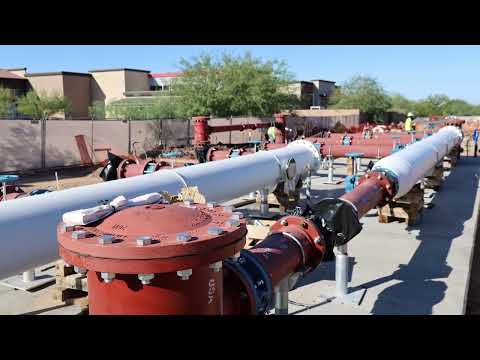
A tangible near-term infrastructure improvement is a new interconnect with the city of Phoenix expected in summer 2026. Staff said the site could provide up to 1.44 million gallons per day of treated potable water—about half the town’s peak-day demand—and includes a new 1 million-gallon reservoir to improve storage and fire protection and to allow maintenance without disrupting service.
On policy, staff reminded the audience that the council adopted a 2021 water-resources policy and a 2022 water-shortage and drought management plan, and that in 2023 the council passed an ordinance to implement those plans when conditions require. The presentation did not include a vote tally or motion text related to that ordinance in the record.
Staff urged conservation actions for customers—efficient landscaping, prompt leak repairs, and reduced indoor water use—and highlighted the town’s My 360 application, which lets users monitor their hourly use: more than 60% of the town’s meters already report hourly data. “The town of Cave Creek is doing its best to ensure long-term water security for all of our nearly 5,000 water customers,” the staff member said.
The presentation framed the town’s approach as a mix of short-term bridging measures and investigation of longer-term options, including potential sale of all or part of the water system to a private utility. Staff described that sale concept as preliminary exploration and gave no timetable or specific partner names for any transaction.
Next steps identified by staff included completing the Phoenix interconnect (summer 2026), continuing negotiations on exchange agreements, finishing well rehabilitation to secure the projected 200 acre-feet per year, and monitoring the Verde River sediment study and any federal decisions that could affect project approval and costs.