Get Full Government Meeting Transcripts, Videos, & Alerts Forever!
Get email alerts on the Landfill Remediation topic
No spam. Unsubscribe anytime.
Whitefish Bay board hears plan to reduce contamination, cap former Good Hope Road landfill
Summary
Consultants told the Village Board the former Good Hope Road landfill contains solvent contamination (PCE/TCE) concentrated on the village-owned 13-acre site, that monitoring shows the plume is shrinking via natural attenuation, and that the Wisconsin DNR will require a source-area mass-reduction plan and likely a cap, which could affect the village's multi-year CIP.
Whitefish Bay Village Board — April 7, 2025 — Consultants from the Sigma Group briefed the Village Board on the history, current monitoring results and next steps for remediation and capital planning at the former Good Hope Road landfill, a 13-acre village-owned property near Lincoln Creek.
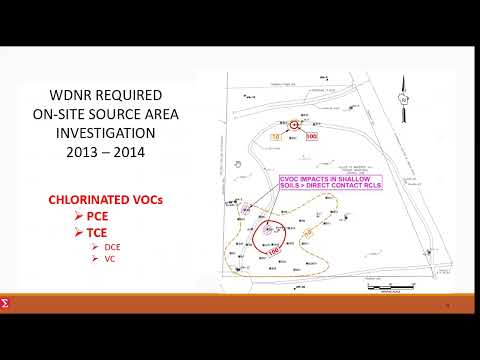
The Sigma Group’s Kristen Kursk summarized decades of investigation and sampling that identified volatile organic compounds on the property — principally perchloroethylene (PCE) and trichloroethylene (TCE) — and explained that those parent compounds are breaking down into daughter products such as vinyl chloride. “We are detectives trying to figure out where the contamination is, how bad it is, where it’s potentially spread to and have a really good understanding of that before we move forward with cleaning it up,” Kursk said.
Kursk and Sigma colleague Misel told trustees that extensive soil borings, monitoring wells and indoor-air assessments at a nearby school and in the residential neighborhood south of the site show the groundwater plume is not expanding and concentrations have trended downward over the monitoring record. The consultants said the data support that natural attenuation is occurring downgradient of the landfill, but that the Department of Natural Resources (DNR) has focused attention on the landfill source area itself and will require a plan to reduce the contaminant mass there.
“The DNR is going to require remediation. It’s in the code,” Kursk said, referring to state requirements that residual source-area contamination be reduced so it will not continue to leach into groundwater in perpetuity.
Sigma outlined remedial alternatives ranging from costly excavation and off-site disposal to in-situ treatment (injections or chemical amendments) that treat contamination in place. The consultants suggested an initial strategy that emphasizes mass-reduction treatment of the source area followed by a landfill cap. They noted that DNR guidance typically references a four-foot potential direct-contact zone but that, in practice, managed caps commonly use a two-foot clean cover with institutional controls and maintenance obligations. Sigma estimated material needs in a soil-cap scenario at roughly 35,000 cubic yards but said final design and quantities will follow further site evaluation.
The consultants described recent DNR requests for additional testing, including two rounds of indoor-air sampling at a portion of the nearby school that has a dirt floor and additional residential soil-gas and potential subslab sampling in the neighborhood to confirm there is no indoor-air risk. Those tests completed in 2023 and 2024 did not indicate an indoor-air problem at the sample locations, Sigma said, but the DNR asked for more empirical confirmation before it will concur the assessment is complete.
Trustees asked questions about timing, the regulatory history (including a 2015 DNR letter of non-compliance), and how remediation and capping would be phased alongside the village’s six-year capital improvement program. Sigma emphasized that deadlines will depend on DNR review and that negotiation is possible if the village presents a reasoned plan that demonstrates measurable progress. Potential future uses — maintained green space, a solar farm, or negotiated redevelopment — were discussed as possibilities after remediation and capping are completed.
The board treated the item as information-only this evening; Sigma said it will prepare a remedial-alternatives and cap-evaluation package for DNR review and that staff will present estimated cost and phasing as part of upcoming CIP discussions.
Kursk concluded: “We’re engaged with the DNR and trying to work alongside them,” and the board recessed the topic for follow-up in the village’s budget and CIP process.