Get Full Government Meeting Transcripts, Videos, & Alerts Forever!
Get email alerts on the Capital Investment Plan topic
No spam. Unsubscribe anytime.
Whitefish Bay begins six-year CIP discussion; staff urges steady water-main and lead-service replacement
Summary
The board kicked off a six-year capital improvement plan, focusing on streets, water, sanitary and storm projects. Staff recommended a long-term program to replace one mile of water main per year with paired lead-service-line replacements; trustees debated pace, staffing capacity and resident disruption.
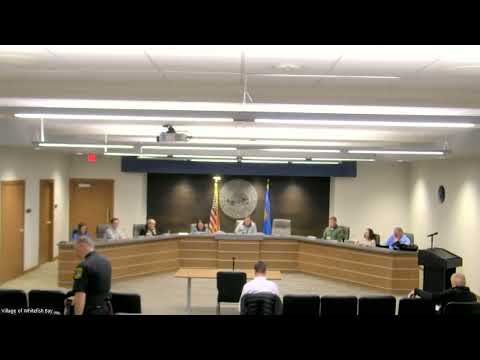
Whitefish Bay trustees on May 19 began a multipart review of a draft 2026–2031 capital improvement plan (CIP) that would accelerate water-main and lead-service-line work and reshape streets and storm-sewer investment over multiple biannual borrowing cycles.
Staff framed the CIP as a six-year roadmap to be refined through summer meetings and consultant analysis. Finance staff told the board the village remains below Wisconsin’s statutory general-obligation debt limit (5% of equalized value) and could, under current assumptions, issue roughly $17.3 million bianually. Staff emphasized those figures are preliminary and that Ellers & Associates will produce a detailed financial plan this year to test borrowing alternatives and bond-rating impacts.
The most significant technical discussion centered on water-main replacement and paired lead-service-line work. Staff said about 80–86% of the village’s mains are roughly 80 years or older and proposed a steady replacement cadence of roughly one mile per year. That approach would involve multi-block trenching, replacement of public and private lead service lines where present, and coordination with street-surface programs so milling/overlay work is not wasted.
Trustees debated speed and staff capacity: some members argued the scale and age of the system require rapid action, while others worried about managing resident disruption and the village’s ability to execute an aggressive first-year program. Staff noted a one-mile annual target would translate roughly to 9–10 blocks and an estimated 180–200 homes affected per year; they said 35 private lead-service-line replacements per year was a feasible staffing target for the early years of the program through contracted and in-house work.
Other CIP elements included proposed Northshore Water Commission projects (plant roof, filter media replacement), sanitary-sewer lining and manhole rehabilitation, storm-sewer inspections and outfall repairs, a reduced mill-and-overlay budget tied to the water-main sequencing, alley reconstruction with MMSD green-solutions funding, and several bike/pedestrian and TAP grant projects. The board set further CIP sessions for June 16 (parks/facilities/equipment), Aug. 4 (regroup) and Aug. 18 (tentative adoption).