Get Full Government Meeting Transcripts, Videos, & Alerts Forever!
Get email alerts on the Tax Incremental Financing topic
No spam. Unsubscribe anytime.
Whitefish Bay board adopts TID No. 3 to support Fox Bay (Argo) and Sendex redevelopments
Summary
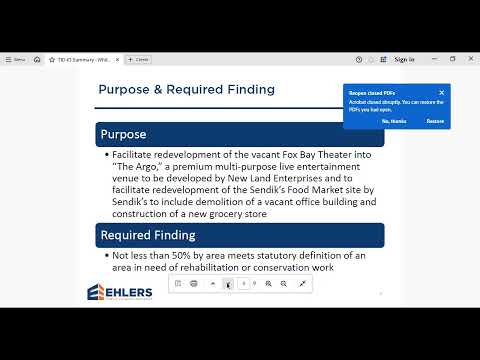
The Whitefish Bay Village Board on May 5 approved Resolution 3180 creating Tax Incremental District No. 3 and its project plan, intended to support redevelopment of the Fox Bay Theater (the Argo) and the Sendex site via development incentives funded by incremental tax revenues, not the general fund.
The Whitefish Bay Village Board voted to adopt Resolution 3180 on May 5, creating Tax Incremental District No. 3 and approving its project plan and boundaries to support planned redevelopment in the village.
Paul, a financial consultant for the village, told the board a TID holds the baseline property value for existing taxing jurisdictions while tax dollars generated by increases in property value inside the district are retained by the TID to pay project costs. "As the value of the parcels in the TID increase in value, that increased value will then generate tax increment dollars," he said during the presentation.
The project plan identifies two known redevelopment projects: converting the vacant Fox Bay Theater into the Argo, a multi-purpose live entertainment venue proposed by New Land Enterprises, and a Sendex-site redevelopment that would demolish a vacant office building and construct a new grocery store. The existing Sendex grocery parcel is intentionally carved out of the district to avoid a temporary decrease in district value if demolition occurs, the presenter said.
Under state law’s 12% equalized-value test, Paul said Whitefish Bay’s total equalized value is roughly $3.4 billion, making the 12% cap about $416 million. He reported the estimated base value of TID No. 3 at the time of creation is about $33 million and that the incremental value attributable to the known projects is roughly $11.3 million. Using conservative assumptions, the plan projects total tax increments of about $4.47 million over the life of the district and estimated annual increments beginning around 2028 of approximately $170,000 under the plan’s modeling.
Paul explained the village will use pay-as-you-go (PIGO) or similar incentive structures that tie payments to developer performance: if a project does not achieve the promised increase in assessed value, incentive payments are reduced. He said that approach prevents direct general-fund spending on the projects and that incentives flow from increments created by the projects themselves. "There's nothing coming from our general fund," Paul said.
The board asked several technical questions about amendments, contiguity, and the requirement that at least 50% of acreage meet the statutory definition for a conservation or rehabilitation district; Paul clarified that the 50% test is an eligibility calculation at adoption and that there is no statutory "clawback" requiring that a set percentage of parcels be rehabilitated during the life of the district.
The project plan includes a projected closure year of 2043 under current assumptions; the allowable statutory lifespan is 27 years, and the cash-flow model will be updated annually at the joint review board meeting. The joint review board and the Community Development Authority previously reviewed the plan; the joint review board is scheduled to reconvene May 28 for final consideration.
The village board moved and seconded the resolution and, after remarks thanking staff and consultants, approved Resolution 3180. The vote was taken by voice; President Buckley announced the motion carried.
What’s next: the joint review board will meet again later in May to finalize district creation and cash-flow updates. If projects do not reach the projected values, the incentive payments will be adjusted under the pay-as-you-go provisions described in the project plan.