Get Full Government Meeting Transcripts, Videos, & Alerts Forever!
Get email alerts on the Municipal Budget topic
No spam. Unsubscribe anytime.
Whitefish Bay board leans toward one-time stormwater rate increase to cover sinkhole repairs; staff to return final figures
Summary
During a lengthy budget session Oct. 28 the Whitefish Bay Village Board reviewed the draft 2025 budget and directed staff to prepare materials for a one-time stormwater-rate increase option to help fund the emergency storm-sewer collapse; estimated impacts were described for average homeowners and utility bills.
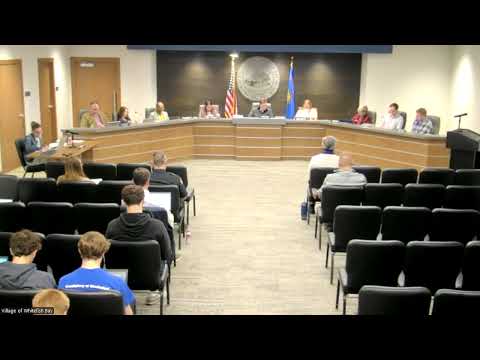
Whitefish Bay village staff and the Village Board spent much of their Oct. 28 meeting reviewing the proposed 2025 budget and debating how to fund the emergency storm-sewer collapse included in the capital borrowing. The board directed staff to proceed with figures and communications supporting a one-time stormwater-rate increase that would shift a substantial portion of the storm-sewer borrow from the property-tax levy to user fees.
Staff framed the choice as three broad funding approaches: keep the storm-sewer collapse fully on the property-tax levy (as modeled in the initial budget), take a one-time stormwater-rate increase in 2025 to move a large portion of the debt to the stormwater utility, or phase stormwater-rate increases across 2025–26. Kelsey and Jamie (village staff) walked trustees through modeled scenarios showing levy and utility effects. Using staff figures, a one‑time increase that moves a significant portion of the storm-sewer borrowing to the stormwater utility would reduce the average homeowner’s projected tax increase in 2025 (compared with full levy funding) while raising the stormwater bill by an estimated amount; staff estimated the stormwater change would equal roughly $18 per quarter for an average home under one of the proposed rate scenarios.
Board members emphasized two equity points in the discussion: (1) funding through the stormwater utility places the cost on properties according to equivalent residential units (ERUs) and would include non-exempt properties (for example, large institutional users), and (2) a property-tax levy approach hits all taxable property owners regardless of individual stormwater runoff contribution. Several trustees said the public is more likely to accept a user-fee explanation linked directly to the visible sinkhole and repair work than a general levy increase tied to reassessment effects.
Trustees asked staff for clearer, line-by-line justifications for some proposed capital and IT purchases and directed staff to seek alternate IT/vendor quotes where costs appeared high (for example, a quoted server and laptop package). The board also discussed trimming nonessential line items where feasible and asked staff to present alternative budget scenarios by email prior to the Nov. 18 public hearing.
Why it matters: The board’s choice affects how much of the storm-repair cost falls on property taxes versus utility bills. Shifting a portion to the stormwater utility reduces levy pressure but increases ongoing utility-rate revenue requirements and raises quarterly bills for ratepayers. Staff emphasized that the funding decision will influence future levy capacity and capital planning.
What’s next: Staff will return with precise calculations and proposed communications for utility-bill inserts and the Nov. 18 public hearing. The board signaled preference for pursuing the one-time stormwater-rate increase option and asked staff to produce the final numbers and public notices.