Get Full Government Meeting Transcripts, Videos, & Alerts Forever!
Get email alerts on the Storm Sewer Emergency topic
No spam. Unsubscribe anytime.
Whitefish Bay board authorizes staff to pursue design‑build fix for Buckley Park storm‑sewer collapse
Summary
After weeks of emergency mitigation at a Buckley Park sinkhole, the Whitefish Bay Village Board approved staff engagement of designers and contractors using a design‑build approach to develop permanent storm‑water repairs, while reserving final budget approval for the board.
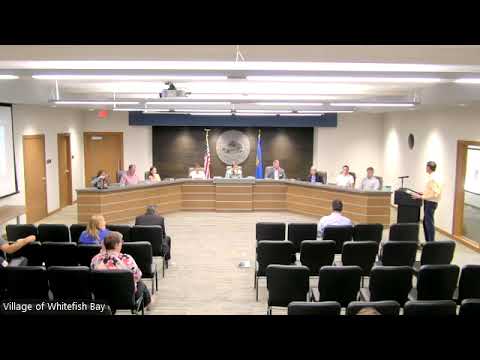
The Whitefish Bay Village Board on July 1 authorized staff to pursue a design‑build approach to develop permanent repairs after a June sinkhole and storm‑sewer collapse in the Buckley Park outfall. The board’s action directs staff to continue engaging designers and contractors on a permanent repair plan, with the explicit caveat that the village board must authorize all budget estimates and contracts before execution.
Director Matt Collins described the emergency response that began June 9, when a storm‑sewer collapse in Buckley Park required immediate excavation and temporary mitigation. “Within four construction days going into the fifth we were able to excavate out 20 feet deep, 45 feet wide in order to create a 36‑inch new pipe as a relief valve,” Collins said, thanking DPW staff and contractors for rapid work that prevented injuries and further utility failures.
Village Engineer Mustafa elaborated on constructability and costs, noting the site’s bluff geology and the project’s unusual depth and equipment needs. Mustafa said typical consulting/engineering fees on large public projects can range from roughly 6–10% of construction cost and warned that a traditional design–bid–build procurement would lengthen the schedule and could shift uncertainty into contractor bids because firms hedge for unknown subsurface conditions.
Collins and Mustafa said the temporary bypass — described as an approximately 30‑inch internal / 36‑inch exterior relief pipe — will handle routine storm events but is not a permanent fix. They told trustees the temporary configuration is sized to manage roughly a 2.5‑inch storm over three hours before surcharge, and staff are pursuing monitoring and float devices and bypass pumping plans to minimize street flooding at identified low elevations (for example, Palisades and Fair Mount).
Trustees asked about schedule, transparency and cost controls. Collins said design‑build could shorten the schedule to about six to eight months versus 12–18 months for a full design–bid–build process and could yield clearer constructability answers earlier because designers and contractors collaborate. He stressed that staff would maintain checks — invoice review, materials verification and contract provisions such as maximum‑guarantee language — and that the village board will retain final authority on budget approvals.
President Kevin Buckley read the staff recommendation to pursue Option Two (design‑build) and to allow staff to continue engaging designers and contractors under that approach, subject to subsequent board authorization of budgets and contracts. Trustee Casper seconded the motion; by voice vote the motion carried.
Next steps include staff and engineers vetting design‑build partners, obtaining more concrete cost estimates, installing monitoring hardware for the temporary bypass and convening a special meeting if expedited budget approval is necessary, Collins said. The board emphasized it would require a subsequent vote before committing public funds to a permanent contract.