Get Full Government Meeting Transcripts, Videos, & Alerts Forever!
Get email alerts on the Zoning Low Density topic
No spam. Unsubscribe anytime.
Jericho planners revise low‑density zoning language, create working groups to encourage smaller and diverse housing
Summary
At its April 7 meeting the Jericho Planning Commission advanced edits to the low‑density residential purpose statement to broaden allowed housing types, set up working groups on small‑house incentives and NRO standards, and asked staff to return redlines; commissioners also debated lot‑coverage definitions and mobile/manufactured home treatment.
The Jericho Planning Commission on April 7 reviewed proposed wording changes to the low‑density residential district and organized working groups to turn broad housing goals into specific zoning language.
Staff member Chris Flynn presented a draft purpose statement that adds housing as an explicit goal and lists a range of housing types "including detached single‑household homes, ADUs, attached townhouses, cottage courts, and small unit buildings," and recommended replacing the town‑plan term "infill" with the more general phrase "residential development." Commissioners agreed to remove the adjective "small" from "multi‑unit buildings" to avoid ambiguity and to change the phrase "additional breaks" to "development pattern" for clarity.
That wording drew pushback from some members concerned the new text could be read to continue broad limits on apartment‑style development outside village centers. Commissioner Chuck said the draft "implies that you're going to continue the ban on apartments in this zone," arguing apartments can be an efficient way to provide housing. Commissioners acknowledged the tension and noted that how the use table and numerical definitions are drafted will determine whether larger multi‑unit buildings remain effectively restricted.
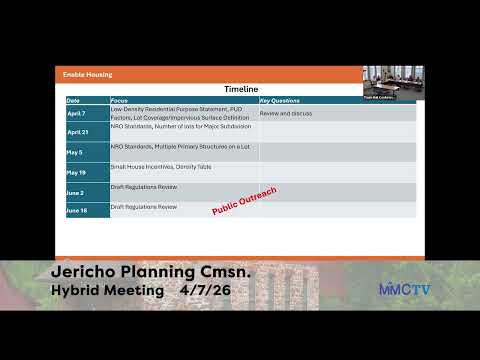
The commission also set a three‑meeting structure for a small‑house incentive working group to identify outcomes, research needs and draft regulations aimed at encouraging smaller, more affordable units through zoning (primarily density‑type incentives rather than direct financial subsidies). Flynn said incentives discussed so far would be zoning‑based (for example, density allowances) rather than direct payments.
On manufactured and mobile housing, commissioners discussed whether zoning should treat manufactured or mobile homes differently and flagged state rules and park regulations as complicating factors. Flynn recommended zoning be written to avoid unintentional exclusion of manufactured homes while recognizing some state rules (e.g., registries for parks) create distinct regulatory pathways.
Commissioners reviewed draft definitions for "impervious surface" and "lot coverage" intended to support stormwater management. The proposals list impervious materials (roofs, paved areas, compacted gravel unless designed as pervious) and define lot coverage as the percentage of a lot occupied by buildings and man‑made impervious materials. Members asked staff to return with application scenarios (e.g., how percentages would operate on minimum‑lot‑size districts versus village districts) and to crosscheck state green‑infrastructure guidance on whether gravel should count as impervious in specific build‑out methods.
A resident commenter who presented compiled 2025 housing data urged the commission to adopt the zoning changes. The commenter said the average new house cost in Jericho in 2025 was $963,000 and that, using a standard affordability calculator, a household would need about $322,000 in annual income to buy such a home. The public comment underlined public concern about housing affordability and supported the commission’s work to expand housing variety.
Next steps: staff will prepare redline language and bring it back for review (the commission expects to see redlines in about a month), and the small‑house and NRO working groups will meet to refine incentive options and technical standards.