Get Full Government Meeting Transcripts, Videos, & Alerts Forever!
Get email alerts on the Charter Revision topic
No spam. Unsubscribe anytime.
New Canaan council schedules straw votes after heated debate over charter changes, elected boards and ethics language
Summary
After a June 10 public hearing on a proposed charter revision draft, the New Canaan Town Council set a June 17 deadline for council input and will take nonbinding straw votes next week on five CRC questions, amid disagreement over posting vacancies, term limits, elected planning-and-zoning and a late ethics proposal.
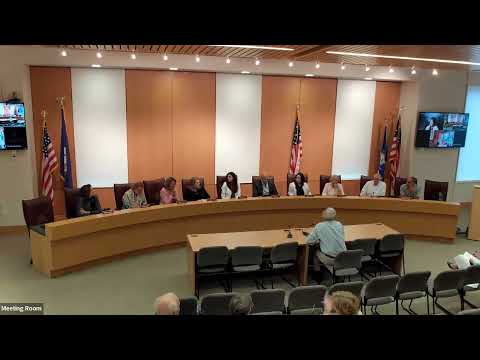
NEW CANAAN, Conn. — The New Canaan Town Council agreed on June 10 to compile council feedback on a draft charter put forward by the Charter Revision Commission and to take nonbinding straw votes at its June 17 meeting on five recommended questions, after public commenters and multiple councilmembers debated whether several proposed changes belong in the town charter.
The discussion centered on three recurring concerns: a CRC proposal to require posting all vacancies on the town website, a CRC recommendation to impose 12-year term limits on boards and commissions, and a proposal to change Planning & Zoning and the Board of Finance from appointed to elected bodies. Councilmember Kim Norton also circulated suggested charter language on ethics and conflicts of interest shortly before the meeting, touching off a separate debate over timing and scope.
The public hearing drew several residents who urged caution about making structural changes. "I don't think this belongs in the charter," said Kevin, a longtime New Canaan resident, arguing that a requirement to post every vacancy would be "intrusive" and could disrupt established town-committee vetting and first-selectman recruitment practices. The comment echoed concerns voiced by other speakers who said posting could be handled by ordinance or standard practice rather than enshrined in the charter.
The town's First Selectman, speaking during public comment, questioned the rationale for broad term limits and elected land-use and finance boards, asking, "What problem are we trying to fix?" He warned that electing Planning & Zoning or the Board of Finance could politicize technical decisions, reduce representation for unaffiliated voters and prompt commissions to defer controversial items during election years.
Charter Revision Commission chair Kathleen walked the council through the statutory timeline and deadlines: the CRC submitted a draft May 4, the council has a narrow window to return recommendations (she noted the council had "15 days to make recommendations to the commission for changes"), and the CRC then has 30 days to issue a final report so the council can decide whether to place proposed amendments on the ballot. The CRC is targeting a final report to the council by July 15.
Several councilmembers urged a pragmatic process for transmitting feedback. Some recommended caucusing to produce a consolidated council report and identifying a short list of priority items for the CRC to reconsider; others said individual submissions remain appropriate and reminded colleagues that many concerns had already been voiced in public hearings. Joe Paulo of the Charter Revision Commission urged the council to present coherent guidance, saying, "The document we gave you on May 4th was a unified document from the commission," and warning that contradictory inputs leave the CRC in a difficult "referee" role.
Kim Norton described her late-day submission as sample language intended to elevate ethics and conflicts-of-interest protections into the charter, calling ethics "the cornerstone of our entire town government." Several members pushed back on the timing and said the proposal'which would expand provisions beyond the town's existing ethics ordinance'should be aired publicly and debated before being forwarded to the CRC.
Chair indicated the council will record nonbinding straw votes at its June 17 meeting on the five CRC recommendations and invited members to caucus and forward prioritized or consolidated comments beforehand. The CRC will consider those inputs and has statutory time to respond in a final report expected by mid-July.
The council took no formal votes on charter amendments at the June 10 meeting; the only formal action recorded was a motion to adjourn, which passed. The council's June 17 meeting will include straw polling and is the immediate next step in the statutory process for possible charter questions to reach the ballot.
Next steps: councilmembers were directed to submit any written recommendations or prioritized items in advance of the June 17 meeting; the CRC will respond within its statutory window, aiming to supply a final report by July 15 so the council can decide by majority vote which questions, if any, to place before voters.