Get Full Government Meeting Transcripts, Videos, & Alerts Forever!
Get email alerts on the Middle Creek Restoration topic
No spam. Unsubscribe anytime.
Lake County supervisors press staff for purchase options on Middle Creek restoration, keep eminent domain on table
Summary
Board heard a status update on the Middle Creek Restoration Project: committee members said Middle Creek delivers the largest share of phosphorus-laden sediment to Clear Lake, reported major progress on land acquisition, and asked staff to return with negotiated purchase options and funding plans — including eminent domain as a last resort.
Lake County supervisors received an update on the Middle Creek Restoration Project and directed staff to return with options for acquiring remaining properties, including negotiated purchase strategies and contingency plans if owners remain unwilling to sell.
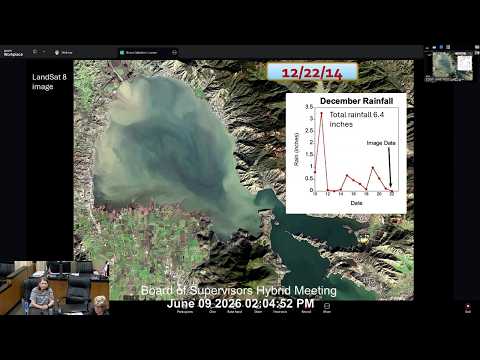
Dr. Mary Joe Velasquez, a member of the Middle Creek Restoration Project Committee, told the board that scientific analyses identify Middle Creek as the largest single source of phosphorus-laden sediment entering Clear Lake and that restoration combining de-channelization and added vegetation could substantially reduce sediment delivery. "It's possible we could get over a production of over 38,000 metric tons per year of sediment coming in Clear Lake with the restoration of Middle Creek," Dr. Velasquez said during her slide presentation.
Committee members reported acquisition progress: about 62% of targeted parcels have been purchased and roughly 5% more have offers pending approval. Combined, the committee said, approximately 79% of the project footprint is either purchased or held in tribal ownership. Still, several owners remain unwilling to sell.
The committee laid out three acquisition pathways: continue negotiation, use district or other local funds to bridge a seller's counteroffer (as done previously in isolated cases), or pursue eminent domain. The committee noted that eminent domain carries legal and trial costs; consultants recommended budgeting an additional legal-cost allowance for each property if litigation occurs.
Officials warned of rising project costs tied to infrastructure and design requirements. Presenters said the Army Corps of Engineers requires projects to reach 35% design and meet program thresholds (project must be doable within three years and cost less than $3 million) to enter Corps evaluation; the Middle Creek effort currently exceeds those Corps thresholds. County staff plan to use earmarked funds to complete NEPA-related program alignment and update reports so the project remains eligible for federal consideration.
Engineering needs to reach the Corps' design threshold include LiDAR surveys, hydrologic and geotechnical studies and sample borings, a county contact (Tyler Miller) said. Flood-line updates around Highway 20 will require mitigation work — options discussed included raising road segments, building guardrails or securing additional right-of-way — and county staff expect mitigation-cost estimates by the end of June from an agency representative.
Utility mitigation also presents a major cost. The committee described two options for PG&E infrastructure: build protective barriers around poles or raise pole bases. Presenters discussed an estimated total in the range of about $9 million for combined transmission and distribution mitigation work.
County leaders said they will pursue Army Corps waivers and federal support. A speaker noted prior legislative and congressional backing for the project and said some federal funds have been provided; the county is also using local cannabis-program funds and watershed-district reserves to sustain near-term work. Committee staff stressed these local and grant funds are intended to keep the project moving while federal alignment continues.
Public commenters asked procedural and technical questions. Angela Emerald asked when acquired parcels would be converted to resource conservation or conservation easements; county staff said the California Department of Fish and Wildlife indicated willingness to wait until parcels are consolidated, though the grant does not require that sequencing. Betsy Khan, who said she is on the resource conservation district board and is president of the Lake County Land Trust, urged coordination with potential Scots Creek watershed restoration work to capture sediment upstream.
Before adjourning the item, the board introduced Michael Badar as the new Middle Creek program manager, tasked with coordinating acquisitions, design milestones and interagency communications. Board members said they had "sufficient direction" for staff: to return with options, funding scenarios and negotiation approaches to advance acquisition. Several members said eminent domain should remain a last-resort option if negotiations and alternative funding fail.
The item closed with the board in agreement and no formal vote recorded in the transcript.