Get Full Government Meeting Transcripts, Videos, & Alerts Forever!
Get email alerts on the Project Blue Stem topic
No spam. Unsubscribe anytime.
Residents urge moratorium as Leavenworth County hears flood of opposition to proposed Tonganoxy data center
Summary
Dozens of residents told the Leavenworth County commission they oppose Cloverleaf’s Project Blue Stem, citing water use, noise, health and property-value concerns; a developer representative said the company will work with local noise rules. Commissioners kept the county's 90-day moratorium in place and asked staff to return with options for an advisory election.
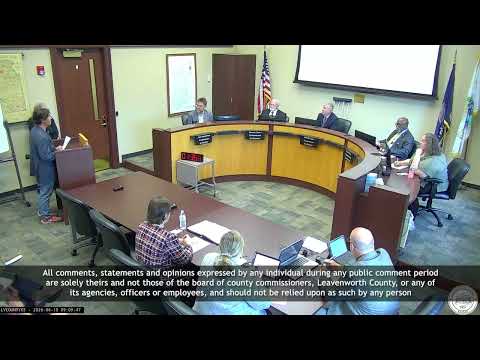
Dozens of residents spoke during public comment at the Leavenworth County Commission meeting, urging the board to halt consideration of Project Blue Stem, a proposed Cloverleaf Infrastructure data center near Tonganoxy, until independent studies on water, noise and public-health impacts are completed.
"I oppose the data center," said Ed Irvin, who identified his winery, saying an engineer told him developers'water-use estimates are often understated and that cooling and open-loop systems can multiply local water demands. "Is it worth the short-term gain for long-term loss?" he asked.
The concerns were wide-ranging: speakers warned of potential drops in property values, chronic noise and "tonal" low-frequency sound, light pollution, impacts on wildlife, risks to private wells and the county's ability to absorb large-scale power and water demand. Jim Carlson, a former educator and state legislator, cited Senate Bill 98 as enabling the economic incentives that make such projects attractive to developers and urged caution.
"This is an issue of process and long-term stewardship," Carlson said. "We need to understand the true costs, including foregone tax revenue driven by state incentives."
Developer Aaron Bill, representing Cloverleaf Infrastructure, responded during the meeting that the company is continuing community outreach and is "willing to work with the regulations you put forward." Bill said many jurisdictions implement limits closer to 60 decibels rather than the 85 dB number that had been questioned in packet materials and that Cloverleaf planned to attend the board's work session to answer technical questions.
Richard Paw, a resident and taxpayer, presented a fiscal critique, estimating that state sales-tax exemptions tied to SB98 could produce very large foregone revenues over two decades when compared with projected local property-tax gains and urged the board to preserve time for a full accounting before proceeding.
Commissioners discussed options for gauging public sentiment. The board directed county staff and the clerk to prepare two or three options for an advisory election (paper ballots) so the commission could consider whether a countywide or localized advisory vote would be informative. Commissioners also heard advice from the Kansas Association of Counties that continuing the existing 90-day moratorium would not impede unrelated battery-storage projects.
The board did not lift the moratorium during the meeting; county staff said the current moratorium remains in effect through August 10, 2026, and no final development approvals were granted.
Why this matters: Project Blue Stem's scale and the state incentives backing data-center development are prompting debates in other states about fiscal and environmental trade-offs. Local residents told the commission they fear irreversible local damage and asked for independent studies, stronger local controls and time for the commission to review long-term costs.
What comes next: The commission asked staff to return with advisory-election options and scheduled a work session for technical briefings from county staff, developer representatives and invited experts. The moratorium will remain in force while the commission considers next steps.