Get Full Government Meeting Transcripts, Videos, & Alerts Forever!
Get email alerts on the School Year Setup topic
No spam. Unsubscribe anytime.
Districts must finish TRS school-year setup to submit 2627 reports
Summary
A TRS presenter walked districts through a seven-page school-year setup required before 2627 reports can be uploaded; the dashboard opened June 1. The session covered payroll schedules (separate training), banking, sick-leave rules, board-paid 9% TRS contributions, flexible benefit plans, and contact upkeep.
A Teachers' Retirement System presenter told school district staff that the TRS school-year setup dashboard opened June 1 and must be completed before districts can upload 2627 reports. "You won't be able to upload any 2627 reports until you have set this school year setup," the presenter said, explaining that districts can continue to upload 2526 reports in the meantime.
The presenter said the setup process is organized into seven pages that must each be opened and marked "review complete"; when saved, the page will show a "reviewed" indicator. Districts must manually return to the school-year dashboard after saving; the front-page dashboard link is available initially but will be removed once setup is finished. The general page requires vendor information and the selection of job categories (teacher, administrator, medical counseling), which determine what other pages will present.
Payroll schedules require separate attention: if a district selects both teacher and administrator job categories, it must add a payroll schedule for each or risk a system error that prevents marking the setup complete. The presenter said payroll schedules are covered in a separate, detailed training because correct schedules are critical to avoiding errors throughout the fiscal year.
On banking and contacts, the presenter urged districts to review current bank account information (districts may use the same account for defined benefit and SSP or separate accounts) and to avoid entering recurring end dates. For the contacts page, districts were told to keep superintendent or director contact information current (rather than using a bookkeeper) so TRS can send superintendent-specific communications; inactive staff should be inactivated and a primary contact reassigned before deletion.
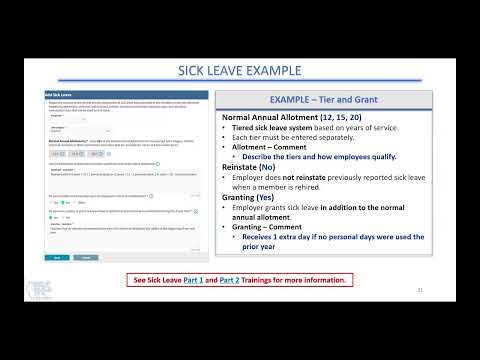
The session reviewed sick-leave entries and the distinction between a normal annual allotment and additional granted days. The presenter advised districts to record tiered allotments by years of service, add an allotment comment explaining the tiers, and state whether the district reinstates previously held sick days when employees are rehired. The presenter illustrated this with a tiered example (different allotments for 0–5 years, 6–12 years, 13+ years) and said districts that grant extra days must document the rationale.
On retirement reporting, the presenter explained the board-paid TRS page asks whether the district pays any portion of the 9% retirement contribution and requested an explanation of who receives board-paid percentages (for example, superintendent, assistant superintendent, other administrators). "If you pay any portion of the 9% contribution, this amount is considered credible earnings," the presenter said, instructing districts to describe recipients and percentages.
Flexible benefit plans were defined as employer options that substitute cash or salary for health insurance; the presenter noted that FSA or HSA contributions do not qualify as a flex plan under TRS rules. Districts that mistakenly answer "no" but later need to report a flex plan were instructed to contact TRS because the option cannot be toggled back by the employer interface. The presenter gave an example district where administrators have flex options of $10,000 or $20,000 (the superintendent's option listed as $20,000; principals listed as $10,000 if they opt out of health insurance) and confirmed there was no minimum FTE for eligibility in that example.
The presenter closed by pointing workshop participants to additional resources and trainings (credible-earnings, service-credit materials, flexible benefit and sick-leave presentations) and listing contact channels for employer services, accounting, and SSP for help with setup questions.
Next steps: districts should log into the dashboard, work through each of the seven pages marking each "review complete," follow up with the separate payroll-schedule training if needed, and contact TRS employer services for any changes that the interface will not permit.