Get Full Government Meeting Transcripts, Videos, & Alerts Forever!
Get email alerts on the Community Concerns topic
No spam. Unsubscribe anytime.
Residents press Tempe on funding, homelessness and noise after Northshore plan presentation
Summary
During Q&A, residents asked about budget sources, coordination on homelessness and noise mitigation near the freeway and airport; consultants said funding is still being developed, maintenance/park-ranger strategies are part of stewardship plans, and vegetation and design can reduce noise.
After the Northshore concept presentation, City of Tempe staff and consultants took public questions on funding, maintenance and design trade-offs.
An attendee asked directly about project funding and whether sales-tax increases would be used. Community Services Director Craig Hayden said the city is "working closely with our budget office" and a financial consultant; "placeholder funds" exist for out‑year design work but "I don't have an identified number" for total capital costs yet.
On park stewardship and homelessness along the canal, Hayden said Parks and Recreation — part of his responsibilities — have increased tools such as park rangers and that the city plans coordinated activation and maintenance as part of long‑term stewardship: "It's a team effort," he said.
A member of the public, identified as David, asked whether planned activities (food trucks, tournaments and small events) would worsen noise because of the adjacent freeway and airport. Designer Diane Jacobs responded that the team aims to mitigate noise through "absorptive materials" and added vegetation, and that the lake and added biomass can reduce perceived freeway sound; Brandon Soak stressed more tree canopy and plantings as a primary mitigation.
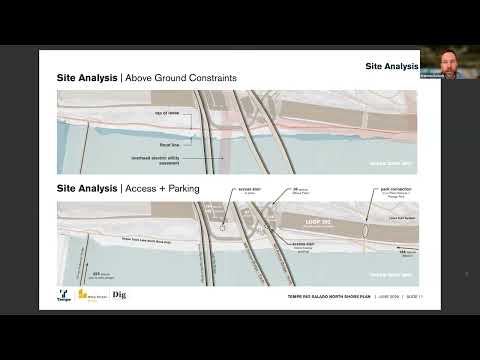
On skate and bike facilities, consultants confirmed conceptual skate spots and pump‑track features with integrated shade were included and that activating space under bridges is desirable but may require coordination with ADOT and parking adjustments.
The presenters said picnic pockets, shaded ramadas and small gathering spots will be considered as the design moves from concept to detailed planning. They urged the public to submit comments through the project website survey, attend the in‑person open house at Tempe Center for the Arts and expect further discussion at a council subcommittee in late summer and a final public meeting in early fall.
The city did not announce specific capital commitments or construction timelines during the session; instead staff framed the effort as a phased planning process that hinges on funding identification and coordination with other agencies.