Get Full Government Meeting Transcripts, Videos, & Alerts Forever!
Get email alerts on the Transportation topic
No spam. Unsubscribe anytime.
Board reviews strong interest in pay-to-ride middle-school buses; officials flag costs and timeline
Summary
Papillion La Vista Community Schools staff reported a 75% survey response rate from eligible families and significant interest in a pay-to-ride middle-school busing option; cost scenarios show district subsidies would be needed under most price points and staff recommended exploring two-leg routes and negotiating pay-to-ride terms in the next transportation contract.
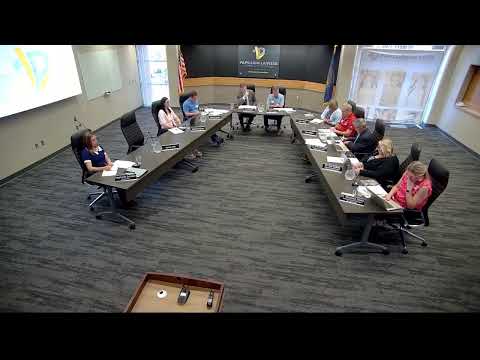
Papillion La Vista Community Schools administrators told the board on June 8 that a district survey found substantial interest in a pay-to-ride middle-school bus program but that implementing the service would likely require district subsidies or route redesigns to be financially viable.
Dr. Villa Royale, who presented the survey and cost scenarios, said the survey targeted the 734 middle-school students who would be eligible under the proposed expanded boundaries and that staff validated 547 responses — a 75% response rate. "We had validated responses for 547 of them, which is a response rate of 75%," she said, and added that 66% of the validated respondents indicated interest in a pay-to-ride program (about 358 students).
The district then modeled four willingness-to-pay ranges and the program's fiscal impact. Using current contracted route costs (about $81,200 per route before a fuel surcharge), staff estimated that fully recovering a single-route base cost would require charging roughly $1,692 per student per year at 48 riders per bus. At that price, the scenario with only 24 likely riders would produce roughly $40,600 in revenue against $243,600 in route costs, leaving an approximately $203,000 net cost to the district for three single-leg routes.
At mid-range price points the models showed smaller but still material net district costs: charging $1,250 per year (46 likely riders) would produce about $57,500 in revenue and a net district cost of roughly $186,100. A $750 price point (125 likely riders) would bring in about $93,700, leaving an estimated $149,900 net cost. The scenario with the most interest (under $500 per year) produced 316 likely riders; staff said seven single-leg routes would be required, with estimated route costs near $568,400 and rider revenue around $79,000, leaving a projected $489,400 district shortfall under the one-leg design.
"To make the costs more accessible," Dr. Villa Royale told the board, staff recommended exploring two-leg routes (which could raise per-route capacity from 48 to 96 students and materially lower per-student costs) and negotiating pay-to-ride terms into the district's next transportation contract or RFP so a vendor might absorb some financial risk. She cautioned that two-leg routing could produce earlier pickup and later drop-off times and raised equity questions about which schools would get preferred time slots.
Board members praised the 75% response rate but warned about the difference between survey responses and actual payment behavior. "When it's time to write a check, the numbers are almost certainly going to look different," one board member said, urging caution about projecting full conversion from declared interest. Several members asked whether the district could move faster than waiting for the next contract cycle; staff and the transportation vendor said the earliest feasible start would likely be second semester of the 2026'27 school year to allow time to build registration, billing and route-management systems and to coordinate with the contractor.
Administration emphasized next steps would include further analysis of two-leg routing, a clear board policy decision on any per-student subsidy the board would be willing to authorize, and additional outreach at the summer retreat and through subcommittees. Dr. Villa Royale said the survey gave a clear demonstration of demand but that implementation requires careful planning to avoid service disruptions and unplanned costs.
The board took no formal vote on the pay-to-ride proposal at the June 8 meeting; members directed staff to return with options and additional cost models for further discussion at future meetings and the board retreat.