Get Full Government Meeting Transcripts, Videos, & Alerts Forever!
Get email alerts on the Crisis Response topic
No spam. Unsubscribe anytime.
Polk County CARES team outlines expanded crisis response, telehealth risk-assessment plan
Summary
Polk County CARES staff said the local crisis center is open with a 24/7 hotline and walk-in hours; staffing shortages will shift some day-shift risk assessments to a telehealth QHP of the day while QHAs handle on-scene support.
Jennifer Lee, a qualified mental-health professional with the Polk County CARES team, told the meeting the CARES building is open and the team operates a 24/7 hotline at 503-623-9289 (press 1); in-person walk-ins are available Monday–Friday from 8 a.m. to 5 p.m.
Lee said the county will adapt day-shift staffing because it has been difficult to recruit QHPs and will send two QHA field staff to some calls while a rotating "QHP of the day" provides risk assessments remotely. "We will have a QHP of the day stationed at the academy building and the one of the two QHAs, one of the people on scene will do the telehealth video thing... and the person that's a QHP of the day, they'll get online, they'll interview the client," Lee said.
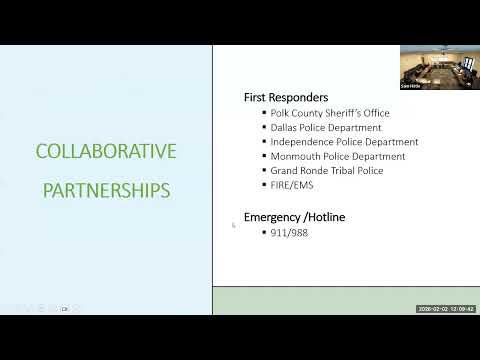
The presentation laid out a stepped-transfer model for 911 and 988 calls: teams aim to transfer emergency-declared-person (EDP) calls to 988 for crisis counseling and safety planning and to return to 911 dispatch if risk or medical needs require a field response. Lee said the system is intended to route people to the right service and reduce the burden on law enforcement and emergency departments.
Speakers described ongoing work to formalize workflows with police, school-based mental-health staff, DHS and hospitals so each partner knows when to step in. Alison Kelly asked whether CARES staff could present to the county mental-health team so those therapists learned available referral paths; Kelly said, "it'd be really good for them to get more educated about all these resources that you've put in place." Lee agreed to follow up and to distribute outreach materials and QR-code cards for first responders.
Lee also described program training and a technical-assistance project to strengthen collaboration and data collection. She urged law enforcement to call for consultations even when a mobile response is not required, saying staff are available to help and that consultations can prevent unnecessary escalation.
Next steps include circulating outreach cards, continuing cross-agency workflow development, piloting the day-shift telehealth model and reporting back to the group on any operational impacts.