Get Full Government Meeting Transcripts, Videos, & Alerts Forever!
Get email alerts on the Strategic Plan topic
No spam. Unsubscribe anytime.
Kyrene reports early-literacy gains and meets belonging target two years early; academic progress still trails goal
Summary
District leaders reported kindergarten benchmark attainment rose to 86% and the district met its five-year belonging target (49%) two years early; overall academic progress remained at 62%, short of the 70% strategic goal, and the board pressed for data on disproportional referrals and AI-in-classroom guidance.
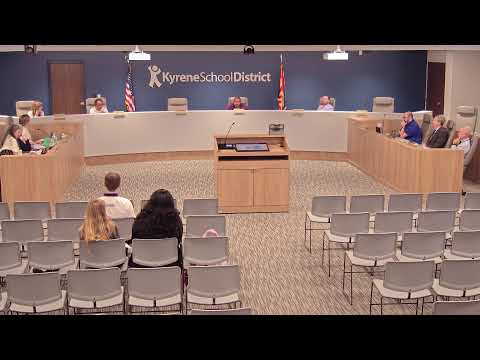
District academic and cabinet leaders told the Kyrene Elementary School District governing board that the district has made measurable progress on several strategic-plan goals while other targets still fall short.
Dr. Susie Osmeire, executive director of accountability and performance management, said kindergarten benchmark attainment rose from 74% to 86%, and the number of schools meeting the 85% benchmark increased from 10 to 14. "These results reflect intentional teaching, strong instructional practices, and an unwavering commitment to student success," she said. First-grade results showed gains but did not yet meet the goal; the district will monitor second grade going forward.
Osmeire reported the district's academic progress metric remains at 62%, short of the 70% strategic goal, and said more focused work will follow in a data dive at the board retreat. She described the district's three-part progress measure (passing, growth, and on-track trajectory) and emphasized that being "on track" carries the greatest weight in the composite score.
The district said it met its five-year belonging objective ahead of schedule: favorable end-of-year survey responses for grades 6'8 grew from a 39% baseline to 49% this year. On equity indicators the district held a 73% score after an earlier jump from 58%.
Cabinet members highlighted related investments and priorities for 2026'27 including sustaining early-literacy gains, embedding technology integration and guidance for AI use in classrooms, designing a comprehensive middle-school model to address growing enrollments per campus, continuing the gifted-program review, strengthening leadership development and modernizing recruitment/retention practices, and piloting a pathway to increase special-education teacher capacity.
Board members pressed staff to clarify why Black students, economically disadvantaged students and students with disabilities appeared overrepresented in referrals and suspensions on the district matrix; Dr. Osmeire said the shaded blue coding in the report shows movement toward proportionality and committed to bringing the underlying calculations and school-level data to the planned data dive.
The presentation included operational notes on technology: the district has an AI guidance framework and is considering family preferences around classroom technology use as pacing and policy evolve.
Next steps: district staff will provide a detailed data dive on academic progress and disproportionality, continue implementing early-literacy and middle-school design work, and advance recruitment and special-education staffing pipelines.