Get Full Government Meeting Transcripts, Videos, & Alerts Forever!
Get email alerts on the Budget topic
No spam. Unsubscribe anytime.
Kyrene school board previews balanced FY2026–27 budget as enrollment drop trims $3.5M in state funding
Summary
Associate Superintendent Chris Herman told the governing board the district faces a projected loss of 593 students and about $3.5 million in state funding, but a combination of state inflation funding, program-weight increases and $4.9 million of reductions will produce a balanced proposed FY2026–27 budget and capacity to invest in employee compensation.
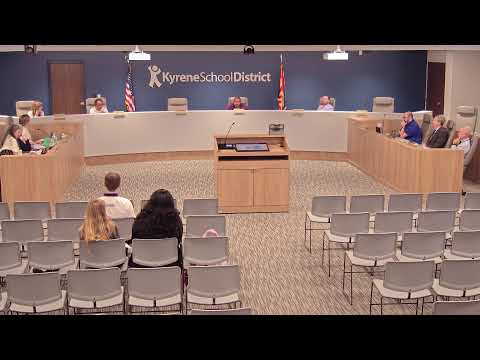
Associate Superintendent Chris Herman presented the proposed FY2026–27 financial picture to the Kyrene Elementary School District governing board, saying the district expects a decline of about 593 students that reduces state "group A" funding by roughly $3.5 million and leaves ongoing M&O revenue down about $200,000 versus the prior year after offsets.
Herman said staff are using a 2% inflation assumption from the state ($1.7 million) while the legislature has not yet enacted a budget, and that the district's seven-year budget report is the starting point for decisions before a proposed-budget vote on June 23. "As of now, the state has not passed a budget for next year. So, the numbers we will review in tonight's presentation are still estimates," Herman said.
To balance the budget, Herman described a combination of permanent reductions and enrollment-driven staffing changes that together total about $4.9 million districtwide, including roughly $1.4 million associated with planned school closures and $900,000 in district-office reductions. He said school staffing allocations will adjust to enrollment formulas and produce roughly $2.9 million in staffing-related reductions, and that the district is not implementing reductions in force: "When reducing personnel costs, Kyne [Kyrene] always looks at attrition, reorganizing departmental work, retirements, or eliminating unfilled positions first," he said.
Herman told the board the mix of inflation funding, group B/experience-index increases and permanent reductions creates capacity to invest up to $4 million in permanent employee compensation for FY27. He also described $7.7 million of one-time expenditures budgeted for FY27, including $2.4 million in employee retention stipends, $1.7 million to cover special-education contracted premiums, $700,000 for operational costs (including contracted bus drivers), and $800,000 to fund 12 additional school counselors using classroom-site reserves.
On special education, Herman said revenues have risen but expenditures have risen faster, producing a multi-year funding gap that contributes to pressure on the general fund. He described the district's long-range "timeless spending model," which targets about 75% of spending in classroom instruction and guides right-sizing decisions to preserve classroom dollars.
Herman summarized the timing for adoption: the board will present the proposed budget and is scheduled to vote on the proposal on June 23, followed by a required public hearing on the adopted budget on July 7 and submission to the state by July 15. He cautioned that state action on a budget could change details and that staff will identify any changes at the June 23 meeting.
The presentation drew questions from board members about how demographer assumptions and school-closure capture rates were folded into projections and about the district's plan if grant funding for counselors changes; Herman said demographer input and closure effects were included in the projections and described using reserves or redirecting future grant receipts to maintain counselor positions if necessary.
Next steps: the board will review any state budget developments and consider the proposed FY2026–27 budget at the June 23 meeting before the public hearing and final adoption in July.