Get Full Government Meeting Transcripts, Videos, & Alerts Forever!
Get email alerts on the Water Affordability topic
No spam. Unsubscribe anytime.
Philadelphia committee advances measures to expand water bill relief and require adjustments for defective meters
Summary
The Committee on Transportation and Public Utilities voted to report two water-related measures to Council: a bill to authorize reductions for bills tied to defective city-owned meters and a companion bill to expand income eligibility for the city’s Tiered Assistance Program (TAP). Testimony included city commissioners, legal advocates and a resident who said her mother was overbilled.
The Committee on Transportation and Public Utilities reported two bills for favorable recommendation after a public hearing dominated by debate over water affordability and billing accuracy.
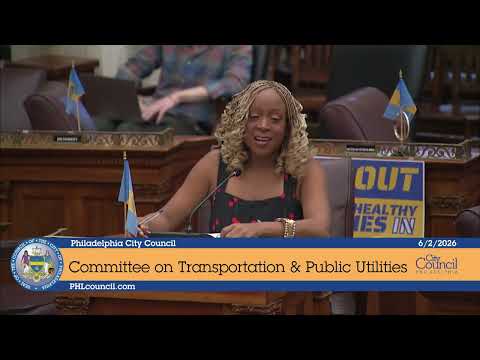
Council Member Gautier, who introduced the TAP expansion, told the committee that rising rates and large makeup bills have pushed many households toward financial crisis and urged passage of bill 251021 to expand eligibility for the Tiered Assistance Program from 150% to 200% of the federal poverty level and to increase eligibility for affordable payment plans. "Water is a basic human right," she said, and described constituent cases she said illustrate the need for change.
The companion measure, bill 251020, would create a clear process to reduce customer bills when city-owned water meters are defective or transmitting inaccurate data. Benjamin Juel, Commissioner of the Philadelphia Water Department, and Kathleen McGan, Revenue Commissioner, testified that advanced metering infrastructure (AMI) is now 97% installed and that departments have revised adjustment policies in recent years to identify and correct anomalous zero or estimated readings. Juel said the departments are working to reduce estimated bills and to intervene earlier when irregularities appear.
Community Legal Services attorney Robert Ballinger and researcher Rebecca Pepe testified in support of both bills. Ballinger said regulations would provide enforceable, consistent relief for customers who face large makeup charges, while Pepe framed water unaffordability as a public-health issue, tying service interruptions and unaffordable bills to risks including missed medical care and housing instability.
Several members pressed the administration on the fiscal note for expanding TAP. Revenue Department testimony outlined a wide estimate — the department presented a range based on enrollment assumptions from 4,000 to 40,000 newly eligible households and corresponding revenue impacts — and warned that, under the current rate model, lost revenue would be recovered from other customers not enrolled in TAP, potentially increasing non‑TAP residential bills. Commissioners said the Water Rate Board would need to set the discount tiers and could alter final impacts.
Family testimony drew a sharper, personal focus. Gigi McGraw testified that her 78‑year‑old mother, whom she said pays water bills in cash and has receipts for every payment, faced unexplained high charges that PWD records did not reconcile: "In 2025 alone, my mother was billed a total of $740; $451 in actual charges. $740 is an overpayment of $288.71," she told the committee and asked that customers not be held responsible for charges tied to defective city-owned meters.
Critics in public comment urged additional oversight. Consumer advocate Lance Haver asked for a management audit of PWD spending and warned that shifting the program cost onto ratepayers is regressive. Water officials and PWD deputy finance staff responded that the department's budget and expenditures are subject to review by the City Controller and the rate board process, and that PWD pursues grants and other external funding where available.
After questions and discussion, the committee approved an amendment to bill 251021 and moved both measures forward with a favorable recommendation by voice vote. The committee recorded the actions as committee reports and recommended that Council suspend rules to permit first reading at the next session.
Next steps: both bills will go to the full City Council for first reading; if TAP eligibility changes, the Water Rate Board must later set the specific tier structures and percentage‑of‑income calculations that determine customers' monthly bills.