Get Full Government Meeting Transcripts, Videos, & Alerts Forever!
Get email alerts on the Demand Management topic
No spam. Unsubscribe anytime.
GSA advisers outline data-driven, locally targeted plan for groundwater demand management
Summary
Hydrogeologist Gus proposed a hybrid framework combining long-window trend detection, model projections and local clustering to phase modest pumping reductions where wells are projected to hit minimum thresholds within 20 years. Committee members urged flexibility, clearer thresholds and board review before any policy.
Gus, the hydrogeologist consultant advising the ROSO GSA advisory committee, laid out a stepwise approach on Tuesday for detecting long-term groundwater declines and responding with locally targeted demand management.
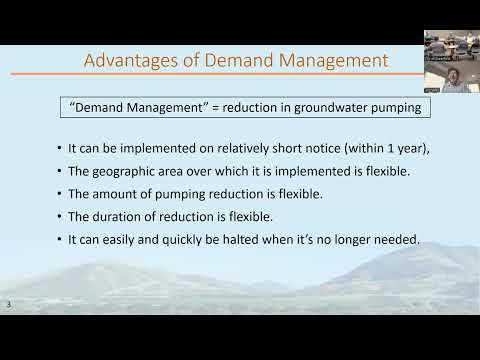
The proposal centers on three elements: use a 20‑plus‑year historical window for trend detection at representative wells, run 50‑year model simulations to see whether current conditions would push particular wells to regulatory minimum thresholds, and map clusters of wells likely to cross those thresholds within 20 years. Gus said those clusters — not whole subbasins — would be the logical places to phase in reductions, starting with a modest 5% pumping cut for five years and increasing in 5‑point steps if trends do not stabilize. “It offers a lot of flexibility to tailor the demand management…to the location where it’s really needed,” Gus told the committee.
The plan is a response to two earlier efforts the committee reviewed: the SMC TAC statistical trend method, which looks retrospectively at five‑year intervals, and Montgomery & Associates’ valleywide framework, which uses model projections and a scoring system linked to 2042. Gus said each approach has strengths — M&A projects forward, and the SMC TAC offers a statistical basis — but neither by itself specifies where, when, and how much to reduce pumping. He recommended combining them so that statistics, visual hydrograph review and groundwater modeling inform area‑specific actions.
Committee members pressed on timing, thresholds and local authority. One member asked why a five‑year evaluation cadence was used if hydrologic conditions can change more quickly; Gus and others replied that annual monitoring would continue, and that the five‑year reviews are a planning cadence rather than a rigid step that prevents year‑to‑year adjustments. Curtis, the committee’s Royal Seiko GSA representative, said the advisory committee would make recommendations but the board would make final decisions.
Public commenters and some committee members urged attention to local variability in land use and crop types. Jerry, a local landowner, described vineyard removals and topsoil changes in parts of the basin and said those land‑use shifts complicate simple assumptions about per‑acre water use. The committee discussed two implementation options: a uniform percentage reduction for all users in a circled area, or an allocation of a fixed number of acre‑feet per acre that would require higher‑use growers to change practices.
On thresholds, several members questioned whether the 2013–2015 drought and reservoir operation anomalies used to set some minimum thresholds skews the baseline. Gus acknowledged the concern and suggested revisiting the threshold choice as part of the GSP update. He also cautioned that statistical trend results are sensitive to the analysis window and recommended hydrologic review to select a representative period that is neither unduly influenced by a wet or dry outlier nor so long that historical changes in cropping and reservoir operations obfuscate current signals.
No votes or formal policy actions were taken. Committee members asked staff to refine the draft procedure, run additional local analyses, and return with a written draft for the advisory committee and then the board. “We’re not at a point where this is ready for prime time,” one member said; the group emphasized that any document circulated would be a draft and that future decisions would be data‑driven and board‑approved.
The advisory committee next plans to refine Gus’s draft, incorporate committee feedback on lookback windows and thresholds, and coordinate with the basin‑wide TAC and neighboring GSAs before presenting a formal recommendation to the board.