Get Full Government Meeting Transcripts, Videos, & Alerts Forever!
Get email alerts on the Land Use topic
No spam. Unsubscribe anytime.
West Hillendale neighbors urge council to block road connections from former Labor College site
Summary
Hundreds of pages of public testimony centered on SRA 26-01, a subdivision regulation amendment proposed to prohibit certain road continuations; neighbors argued proposed connections would overwhelm narrow residential streets, harm safety and fragment natural buffers while property owner representatives warned the SRRA could obstruct master-plan redevelopment.
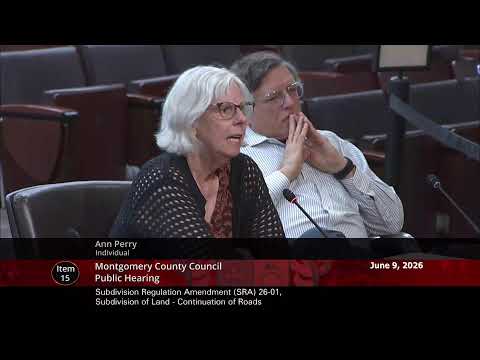
At a lengthy June 9 hearing, residents of West Hillendale and nearby neighborhoods strongly supported SRA 26-01, which would prohibit the continuation of neighborhood streets for certain classifications and thereby limit potential vehicular connections from the 46-acre former National Labor College site in White Oak.
Neighborhood leaders including Nancy Stark and Larry Ta described narrow, single-lane "neighborhood yield" streets, proximity to two schools and a volunteer fire department, and an existing tree and stream buffer that makes a direct road connection both environmentally and operationally problematic. Speakers argued that channeling traffic for 110 planned townhouses through narrow residential streets would cause congestion, create emergency-response risks, and degrade quality of life. Several residents said development proposals contemplated widening rights-of-way that would remove front yards and mature trees.
Representatives for the property owner (Amalgamated Transit Union) and developers urged caution about using a subdivision regulation amendment to limit connections, saying the Planning Board and fire/rescue agencies should retain the ability to review transportation and safety in the site-plan process. Francois Carrier (counsel) said the SRRA could preclude safe and efficient access options and argued connectivity decisions should be reached in the regulatory application process rather than by a blanket SRA.
Neighbors said existing regulatory avenues had not provided sufficient certainty and asked the council to adopt the SRRA to preserve community safety and natural buffers. The hearing closed after dozens of residents gave testimony; the transcript shows the council will consider the competing planning and neighborhood interests in future committee discussion.