Get Full Government Meeting Transcripts, Videos, & Alerts Forever!
Get email alerts on the Utilities Water Rates topic
No spam. Unsubscribe anytime.
Connecticut Water asks PURA for 21.4% rate increase; parties set schedule and public outreach plan
Summary
Connecticut Water asked the Public Utilities Regulatory Authority for a 21.4% rate increase (about $28.8 million) driven primarily by roughly $145 million of plant investment. Commissioners and intervenors discussed a late-July/September schedule for testimony and hearings, public educational outreach, and filing formats.
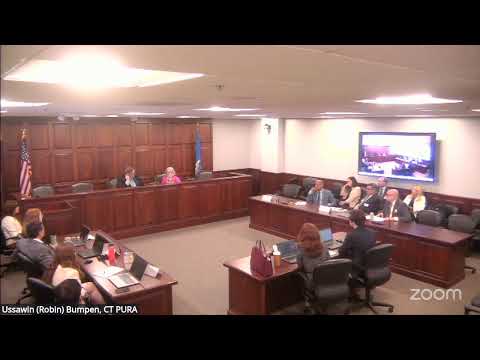
Connecticut Water told the Public Utilities Regulatory Authority during a scheduling conference that it is seeking a 21.4% rate increase, asking the regulator to approve $28.8 million in additional annual revenue driven mainly by about $145 million in new utility plant investment.
"So that all culminates into what is a 21.4% rate request in this case," Troy Dixon, a company representative, said as he summarized the filing. Dixon said the company is proposing a one-year rate plan with a test year of calendar 2025 and used Feb. 1, 2027, as a clean example of an effective rate year for presentation purposes.
Why it matters: Connecticut Water said roughly 71.5% of the requested increase is attributable to new plant investments and associated rate base; another share reflects higher operations-and-maintenance costs and lower customer consumption than previous rate assumptions. Craig Patlom, president of Connecticut Water, told the panel that tighter water-quality measurement and efforts to remove PFAS are among the drivers of recent investment.
"We're discovering new things in water, and it is upon us as a water utility to begin that removal process, speaking predominantly of PFAS," Patlom said.
Company details and witnesses: The utility said it serves roughly 108,000 mostly residential customers across about 60 Connecticut communities and described a capital program it wants the parties to align on. The company listed five internal witnesses and two external consultants: ScottMadden will provide witnesses on return-on-equity and the cost-of-service study (Dylan De Ascendis was named as an ROE witness).
Procedural and scheduling outcomes: Commissioners and parties discussed scheduling trade-offs and availability. Multiple parties favored a schedule that would allow prefiled testimony in late July, discovery in August, and evidentiary hearings in September (subject to calendar conflicts and other pending rate cases). The authority said it will publish a docket schedule soon.
Public outreach and hearings: PURA proposed an educational presentation for the public explaining how rate cases work; OCC indicated it would present a high-level view of the application at public comment sessions to reduce public confusion about the process. The parties also discussed holding a mix of in-person and virtual public hearings in locations across the company's service territory to improve accessibility.
Filing logistics: The chair raised an informal request that filings be submitted as PDF or Excel rather than Word to ease real-time review in hearings. Parties discussed batching vs. individual PDFs for interrogatory responses and whether to submit a single compilation of narrative responses at the close of record.
Billing and effective-date mechanics: Commissioners asked how an effective date tied to a final decision would be implemented operationally. Dixon said the company's billing system prorates service across cycles and that the company would likely hold bills briefly while testing and submitting compliance tariff filings to ensure rates are applied to the correct service periods.
Next steps: PURA said it will consider the parties' scheduling proposals, provide guidance on filing formats and public outreach based on experience from recent cases, publish a docket schedule, and return to the matter as the schedule dictates. "We will take everyone's ideas and proposals under consideration," Commissioner Jan Beecher said before adjourning the conference.