Get Full Government Meeting Transcripts, Videos, & Alerts Forever!
Get email alerts on the Special Education topic
No spam. Unsubscribe anytime.
Special‑education director: cooperative reached over 90% response rate and all 24 surveyed graduates were in school, training or competitively employed
Summary
Director of special education Chris Cullinin told the Tonganoxie Board that the cooperative reached just over a 90% response rate on post‑school surveys for a 24‑student cohort, and 100% of that cohort were enrolled in higher education, training or competitively employed; staff noted funding declines in categorical aid over three years.
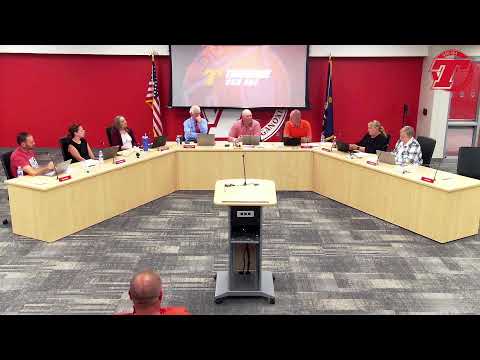
Chris Cullinin, director of special education for the cooperative that serves Tonganoxie, told the school board on June 8 that the district’s special‑education staff achieved unusually high post‑school outcome survey results for the cohort in question. Cullinin said the cooperative reached just over a 90% response rate for that graduating class of 24 and that every respondent was either enrolled in higher education, enrolled in a training or technical program, or competitively employed.
"We started calling our own students," Cullinin said, describing why the district’s response rate exceeded the Kansas average. "Our staff does an excellent job building relationships with kids and connecting with them, and so by us calling them, we're able to get a lot better responses." He said that, for that graduate class, 100% were engaged in post‑secondary education, training or employment.
Cullinin also reviewed routine progress reporting and program metrics: about 90% of special‑education students showed progress on their IEP goals in the fourth quarter, and the cooperative ended the year serving 363 students — roughly 18.8% of the district’s enrollment, a mix of students with disabilities and those identified as gifted. He said the cooperative identified 62 students for special‑education evaluation this year and dismissed 21 students who met goals and no longer required services.
Cullinin framed the cooperative’s priorities this year as communication, professional development and fiscal responsibility. He described new practices — biweekly emails to staff, targeted professional development for paraprofessionals, and brief administrator PD sessions — and said the cooperative expects to finish the year under budget, allowing it to strengthen cash balances heading into next year.
On funding, Cullinin warned of continuing pressure: categorical aid from the state has decreased in recent years, he said, listing a 3.8% decline this year following a 4.8% drop the year prior and a 2.7% drop the year before that — a cumulative 11.3% reduction in categorical aid over three years. He asked the board to continue advocacy with state legislators about special‑education funding, emphasizing statutory expectations for state reimbursement of excess costs.
Board members asked how they could help; Evan praised the Indicator 14 results and noted that the Kansas Department of Education had taken notice. Cullinin said he will send more detailed indicator data to the superintendent for distribution to the board.
The board did not take separate action on the cooperative report; questions were addressed during the presentation and subsequent discussion.