Get Full Government Meeting Transcripts, Videos, & Alerts Forever!
Get email alerts on the Museum topic
No spam. Unsubscribe anytime.
PALA New Town presents museum plan; commission directs staff to negotiate contract and serve as liaison
Summary
PALA New Town Inc. outlined a five‑year plan to operate a New Town Museum at the Jenkins Gymnasium and requested a $25,000 annual city contribution; commissioners agreed that staff (acting city manager with city attorney involvement) will act as liaison and bring a final contract back for a June 11 vote.
PALA New Town Inc. asked the Palaca City Commission on May 28 to approve a partnership that would place a New Town Museum and cultural arts program in the Robert H. Jenkins Gymnasium, with the nonprofit managing day‑to‑day operations and the city providing the facility and an annual operating contribution.
"We stand before you as PALA New Town, Inc., the nonprofit organization that was funded as part of [the steering committee] to make this a reality," said Tero Hill, who presented the draft agreement and the board’s plan for operations, fundraising and preservation of artifacts. Hill told commissioners the project is supported by a state African‑American heritage grant (stated in the presentation as $690,000) plus roughly $310,000 in ARPA funds and described a draft five‑year operating agreement that would begin on a July 1 start date if approved.
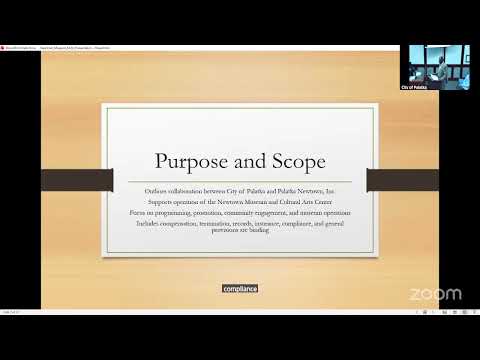
Under the draft terms shown to the commission, New Town would manage exhibits, educational programming, donor relations and exhibit permissions; the city would provide the Jenkins Gymnasium spaces (locker rooms to be converted to museum spaces), cover utilities, and receive a 10 percent remittance on donations and fundraising revenue (restricted grants and processing fees excluded). The agreement as presented would also provide for annual financial reporting, a right to audit records and a seven‑year records retention schedule. Hill said New Town would staff the museum and coordinate hours and programming and described the $25,000 requested from the city as seed operating support and part of a fundraising and revenue‑sharing approach.
Commissioners probed timing, staffing and negotiation authority. Commissioners asked whether the $25,000 would cover staffing and whether events or a gala could reduce the city’s contribution in subsequent years. Hill said the $25,000 would support New Town’s staffing plan and that fundraising could offset city costs.
"I would like to just thank the committee for all the work they've done in putting this together," Commissioner Campbell said, adding that the presentation answered questions about what the nonprofit was asking from the city.
Hill asked the commission to identify a liaison or provide direct negotiating authority to staff so the parties could complete a final draft consistent with commission expectations. Commissioners debated whether to designate a commissioner as liaison (raising sunshine‑law concerns) or to rely on staff. The commission voted to have the acting city manager, with involvement from the city attorney, serve as the liaison and to direct staff to continue negotiations and return a final contract for formal commission action at the June 11 meeting.
What happens next
Staff will work with the PALA New Town steering committee and city legal counsel to reconcile draft contract terms, clarify financial reporting and audit rights, and return a final agreement for commission consideration on June 11. The commission’s direction was procedural: it did not approve the final contract or the funding at this meeting, but it did authorize staff to negotiate and bring back a ratifiable draft.