Get Full Government Meeting Transcripts, Videos, & Alerts Forever!
Get email alerts on the Urban Forestry topic
No spam. Unsubscribe anytime.
Consultant Mike leads pruning workshop to revive Torrington community orchard
Summary
A hands-on workshop at the 5 Points art center property in Torrington taught residents pruning, pest management and bracing techniques aimed at restoring an orchard planted by university students in 2012–2013; city staff said the effort supports food access and tree stewardship.
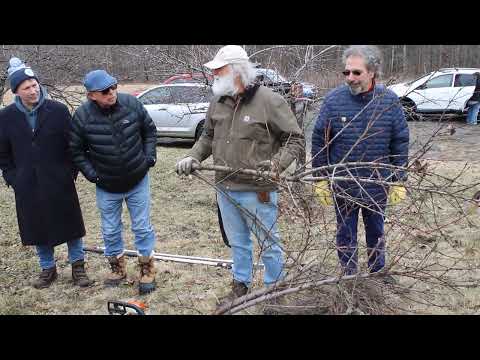
At a hands-on workshop on property owned by the 5 Points art center in Torrington, Nate Nardi Cyrus, assistant city planner for the city of Torrington, and a local arborist led residents through pruning and orchard-care techniques intended to revive an orchard students planted in 2012–2013.
The volunteer-led session focused on basic tree biology, correct pruning technique and long-term structural care. Mike, a former licensed arborist and landscape consultant, framed the work as stewardship: “Trees cannot move. They either survive or die,” he said, warning that planting without follow-up often leaves trees vulnerable.
Why it mattered: the site is a community orchard the students planted to provide free fruit to residents, and the conservation commission’s outreach goal is to return the trees to productive, sustainable condition. Nate Nardi Cyrus said the conservation commission partners on such projects to combine education with on-the-ground stewardship.
Key takeaways from the demonstration included: pruning to preserve the branch bark collar and avoid flush cuts that remove the protective swelling and invite disease; limiting severe cuts (Mike said his rule-of-thumb pruning for this approach removes roughly one-third of wood per year); and tailoring pruning to species — apples form broad scaffolds while pears and stone fruits often need different topping or propping strategies.
Mike demonstrated how to make correct removal and finish cuts, described the branch bark collar and credited Dr. Alex Shigo for modern compartmentalization-based pruning practices. He advised the two-cut method for larger limbs to prevent tearing and recommended angled cuts to favor outward buds.
On pests and organic treatments, Mike described using a clay “surround” applied after petals fall to block fungal hyphae and deter the plum curculio, and mixing Bacillus thuringiensis (BT) for caterpillar pests. He also recommended composting at about 138°F for three days to reduce pathogen risk. For fertilization, he advised a soil test (for example a UMass test) before adding nutrients and cautioned that boron can be toxic if overapplied.
Structural care covered bracing and bolting techniques: Mike suggested stainless-steel bolts and properly installed cleats or props (for example a 2x6 or locust post) instead of tight straps that can girdle cambium. He described drilling a through-bolt with washers to join rubbing branches and using carefully placed props to support heavy limbs.
Attendees asked species-specific questions (peaches, plums, apples) and watched demonstrations on choosing outward-facing scaffold branches, dealing with mummified fruit, and using ARS pruners to reduce ladder work. Organizers emphasized that the restoration is multi-year work and invited attendees to continue asking questions during the hands-on pruning that followed the presentation.
There were no formal motions or votes recorded at the event; it was an instructional, community stewardship workshop hosted in partnership with city planning staff and the conservation commission.