Get Full Government Meeting Transcripts, Videos, & Alerts Forever!
Get email alerts on the Parks Policy topic
No spam. Unsubscribe anytime.
Norman staff propose park‑dedication and development changes, and council weighs stronger park rules after Francis Kate encampment
Summary
Parks staff recommended modernizing a 1976 parkland dedication ordinance, restructuring fee buckets and raising per‑dwelling impact fees to speed park projects. Park board urged codifying park rules (including no‑camping in parks); council generally supported exploring ordinances to give police immediate enforcement authority.
City Parks staff told the Norman City Council that several park-related ordinances have not been substantially updated in decades and proposed a package of changes that would alter how parkland is dedicated and funded, refine tree protections and give council options to codify park rules after recent encampments.
Jay Olsson, the city’s Director of Parks and Recreation, said Norman’s parkland-dedication policy dates to 1976 and that the city now operates more than 70 parks. He said the department wants to tighten how "fee in lieu of land" is calculated—working with the county assessor to set an annual market‑based per‑acre valuation—so the city can use those funds strategically for future purchases or improvements. "Park playground in 1994 cost $35,000. Right now a park playground in a neighborhood is upwards of $200,000," Olsson said, arguing that current fee buckets and the $150 per‑dwelling fee are insufficient to avoid lengthy delays in park construction.
To accelerate projects, staff proposed consolidating many small fee buckets into four larger categories and increasing per‑dwelling fees, with proposed ranges discussed in the study session of roughly $200 to $400 depending on whether the development provides private parkland or is within a mile of an existing park.
Tree protections and historic‑tree districts were also on the agenda. Staff proposed clarifying that regulated trees are those in the public right‑of‑way (between curb and sidewalk), establishing processes for nomination and maintenance of historic tree districts and creating a permitting/licensing program for commercial tree work.
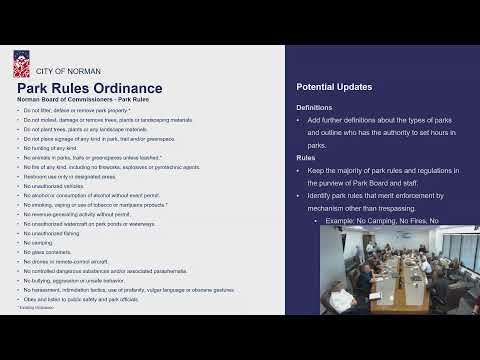
Park rules and enforcement drew particular attention after an encampment at Francis Kate Park and a Park Board request that certain rules be codified. Olsson and city legal staff explained the difference between park rules (set by staff or Park Board and typically enforced by trespass notices) and municipal ordinances, which allow direct citation and fines. "If council passed an ordinance that says no motorized vehicles in the park, I don't have to worry about trespassing—you can be cited right then," staff said.
Council members asked about practical details—whether e‑scooters or battery‑assist bicycles would be treated as motorized vehicles and how geo‑fencing and permitting for pavilion use would work. Council Member Hinkle asked if the motorized prohibition would capture lime/bird scooters; staff said the goal is to prevent damaging, off‑road motorized vehicles while allowing normal bicycle access and that geo‑fencing has been used elsewhere to disable shared devices inside parks.
Outcome/next steps: Council generally expressed support for pursuing ordinance options that give police clearer enforcement authority on issues such as camping, fires and unauthorized motorized vehicles, and directed staff to continue refining proposals. Staff said the items will return for further consideration at a future meeting.