Get Full Government Meeting Transcripts, Videos, & Alerts Forever!
Get email alerts on the Septic Variance topic
No spam. Unsubscribe anytime.
Bourne board approves septic variances for 411 Sada Avenue with roadside membrane condition
Summary
The Bourne Board of Health approved local variances to allow a septic system closer to the property line and with reduced cover at 411 Sada Avenue, adding a requirement for an impervious membrane along the roadside to protect the excavation.
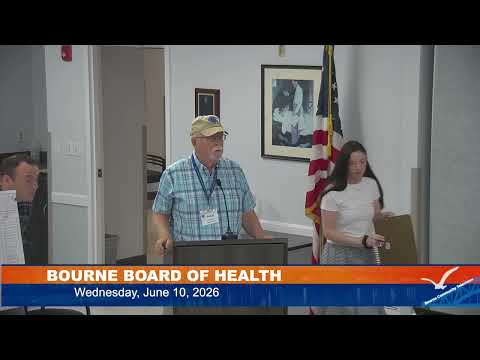
The Bourne Board of Health voted June 10 to approve local variances allowing a proposed septic system at 411 Sada Avenue to be sited closer to the property line and with reduced cover, adding an impervious membrane along the roadside as a condition.
Lucas Amato of Bracken Engineering, representing owners John and Sally Bonanzio, told the board the project would raise and rebuild an existing three‑bedroom dwelling built about 1900 and that lot constraints required the requested local upgrade approvals. "We are proposing to raise and rebuild the existing dwelling that was built in 1900," Amato said, explaining the need for a four‑foot setback variance and a 1.2‑foot waiver on depth of cover to reach native material for the soil absorption system.
Board members and staff questioned whether pressure distribution or other nitrogen‑management measures were needed. Katie, a board staff member, said the property is not in a nitrogen‑sensitive area, is more than 120 feet above groundwater and therefore "we aren't in a nitrogen sensitive area" and the project does not trigger stricter state requirements. The board also discussed construction safeguards for the sandy soils and encouraged measures to protect the roadside excavation; one member recommended steel sheeting and the board added an impervious membrane as a written condition.
During public comment, Bob Dwire, vice president of the Picassid Water Quality Coalition, urged the board to consider long‑term implications if the local water body is later declared nitrogen‑sensitive after a pending TMDL is approved by state and federal regulators. "By a year from now this water body is going to be declared a nitrogen sensitive area," Dwire said, and he warned that future retrofit requirements could make smaller sites difficult to accommodate.
After brief additional discussion, a board member moved to approve the variances "as proposed this evening with the addition of an impervious membrane by the side of the road." The motion was seconded and the board voiced assent.
The approval is conditional on the added roadside impervious membrane to safeguard the excavation and adjacent roadway; the board did not record a roll‑call vote in the transcript, and the motion was carried by voice vote. The board did not order any immediate nitrogen‑removal retrofit; staff noted the property is outside the area currently designated as nitrogen‑sensitive but that an upcoming TMDL could change future requirements.
Next steps: the applicants are expected to include the impervious membrane in construction drawings and proceed with local permitting and building department occupancy procedures.