Get Full Government Meeting Transcripts, Videos, & Alerts Forever!
Get email alerts on the Sewer Billing topic
No spam. Unsubscribe anytime.
Yorktown board advances plan to shift sewer O&M charges from property tax to water-based billing
Summary
After a long public hearing, the Yorktown Town Board approved changes to local sewer law intended to move operation and maintenance (O&M) costs from property-tax levies into a water-consumption sewer rent; board members and residents pressed staff for parcel-level impact analysis and likely higher per-thousand-gallon rates.
The Yorktown Town Board on May 19 approved changes to the town’s sewer code that pave the way for shifting operation and maintenance costs off property-tax bills and onto a sewer "rent" charged on water consumption.
Town presenter Dan told the board the goal is to simplify a patchwork of roughly 13 special sewer districts and establish a uniform method to recover O&M costs. "What we're trying to do here is... consolidate [districts] and have something that's equitable to all," Dan said during a detailed presentation of rates and revenue scenarios.
Why it matters: Board members and residents told the board the change could make billing fairer for households that currently carry disproportionate tax charges, but they warned many households may see higher bills under a consumption-based system. Presenter Dan said the proposal would convert some tax-funded district levies to charges on water consumption and make the town’s collection methodologies consistent.
What was discussed: The presentation compared current rates (Yorktown at $120 per 1,000 gallons; several Peaksville-area rates at $150) and modeled revenue under several per-thousand-gallon scenarios. Dan repeatedly said the town's 2026 budget and historical water-consumption data will guide final rates; board members pressed him to return with parcel-level winners-and-losers analysis.
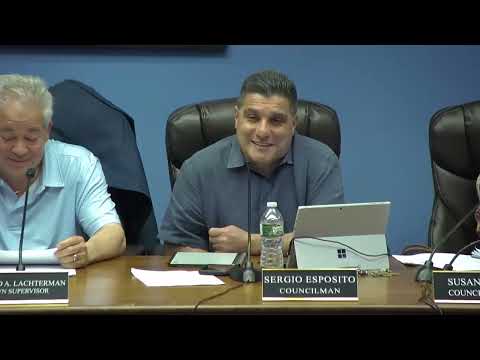
Board pushback and next steps: Deputy Supervisor Sergio Espazito and at least one other board member said they lacked confidence in the current numbers. "I didn't get an answer" to how many homeowners would see higher bills, Espazito told the board, requesting clearer impact estimates before final rate-setting. The board closed the public hearing and moved forward with the local law language; members said the transition will include a data-collection year and that the town expects to set concrete rates in a later vote (staff suggested 2027 as a target for full implementation).
Public comments and technical concerns: Several residents and technical commenters asked whether irrigation, swimming-pool filling and exterior watering (which can inflate water use without adding sewer flow) would be accounted for; town staff said smoke testing, TV inspection results, meter data and minimum-consumption rules will be part of the implementation design.
What happens next: The board approved the local-law changes needed to enable the transition while directing staff to return with refined rate options, parcel-level impact modeling and a clear schedule for the move from tax-based to consumption-based billing. Any change in the per-thousand-gallon rate will be set by the board after the town compiles water-usage data and completes required public notices.