Get Full Government Meeting Transcripts, Videos, & Alerts Forever!
Get email alerts on the Zoning Databank Parking topic
No spam. Unsubscribe anytime.
Red Oak council denies Databank request for temporary construction parking after resident objections
Summary
After hours of public comment about traffic, noise, dust and transparency, the Red Oak City Council voted down Ordinance 26‑016 (ZC26‑08), a request that would have allowed Databank to use roughly 61.63 acres for temporary construction parking and logistics; the motion failed on a 0–4 roll call requiring a four‑member supermajority.
The Red Oak City Council on a roll‑call vote rejected a developer request to rezone about 61.6316 acres to allow temporary construction parking and logistics for the Databank campus, saying resident concerns over traffic, dust, noise and transparency outweighed the applicant's requests.
The measure, introduced as Ordinance 26‑016 (ZC26‑08), would have reclassified PD land development 164 (Revised 3) to PD 164 (Revised 4) to permit construction parking, staging and related materials storage on land north of Standback along Bachelor Road. Planning staff told council the applicant had proposed temporary parking for up to three years, with a flexible aggregate (“flex base”) surface, visual screening and no permanent lighting; the Planning & Zoning Commission recommended denial and the council was reminded that overturning PNZ required a supermajority of all members (four votes).
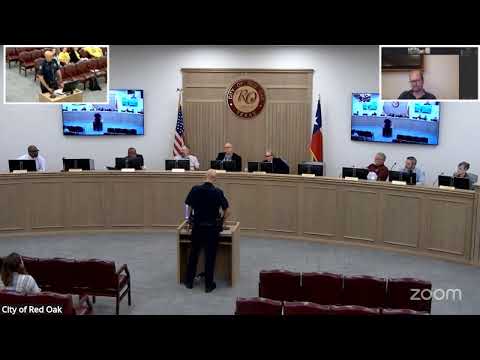
Residents filled the council chamber and urged denial. "The agenda was deliberately misleading," said Pat O’Connell, who criticized how the item was described to the public and questioned compatibility and technical noise standards. Katherine Floyd told the council that Databank had expanded its workforce far beyond original projections: "They now have 2,000 workers on site," she said, urging the company to use buses rather than additional neighborhood parking and traffic. Elder Jasine Viaz said approving exceptions for developer schedule problems would set a precedent, asking council to prioritize nearby homeowners.
Databank representatives, including Tony Cory, vice president of construction, said the company worked with staff to limit impacts and would enforce site rules. Cory responded to residents’ operational complaints and said he would investigate reports of vehicles exiting an emergency gate and would follow up on easement and piping concerns: "If there was in fact 30 cars that came out of that back entrance, I will look into that tomorrow when I'm on the job site," he said. The applicant detailed mitigation proposals: chain‑link fencing with wind/visual screening, no additional parking‑lot lighting for the temporary lots, erosion‑control measures around compacted flex base surfaces, and a proposal to limit the temporary period to three years (with any extension requiring another council review).
Staff told council the off‑site parcels as drawn showed approximately 1,800 parking spaces on a larger southern parcel and additional 200 and 514 spaces on smaller adjacent parcels, with on‑campus parking near building 16 of roughly 1,200 spaces. Staff also reported the nearest existing structures would be about 210–300 feet from the proposed temporary parking edges and emphasized conditions to return the area to pre‑development (grass) once temporary use ended.
After council discussion and a motion to approve Ordinance 26‑016, the vote failed 0–4 (the item required four affirmative votes to override PNZ). City legal and staff confirmed the denial means the requested zoning for the proposed temporary parking and staging is not authorized; the applicant may resubmit alternate plans to Planning & Zoning for reconsideration.
Council members and residents repeatedly asked for firmer operational guarantees from the developer — including a smaller temporary footprint, greater use of busing and more explicit enforcement steps for trucks and subcontractor access. Several speakers asked the city to preserve buffer areas and to provide residents earlier access to full agenda packets and attachments so the public can better evaluate large, phased developments.
The council moved on to other business after the vote, approving several board and commission appointments and receiving department updates on the budget schedule, fire station progress and parks and library events. The meeting adjourned at about 9:16 p.m.