Get Full Government Meeting Transcripts, Videos, & Alerts Forever!
Get email alerts on the Land Use topic
No spam. Unsubscribe anytime.
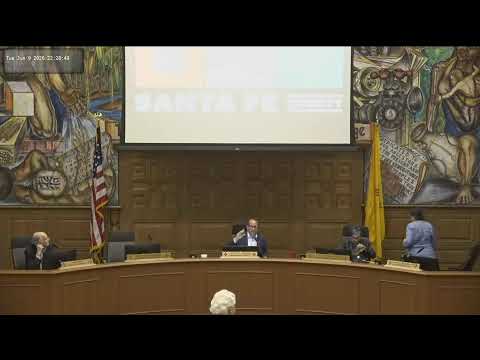
Santa Fe County commissioners table conceptual plan for large housing project pending further review
Summary
The county commissioners voted to continue review of a conceptual plan for a multi-parcel housing development to June 30, asking staff to verify density-bonus calculations and to bring DOT, fire department evacuation analysis, crash data and wastewater permitting details.
Santa Fe County commissioners voted to continue consideration of a conceptual plan for a proposed housing development, directing staff to return with verified density-bonus calculations, traffic/crash data, New Mexico Environment Department permitting details and fire-department analysis of evacuation capacity. Commissioner Kakari Stone made the motion to table; Commissioner Hughes seconded it and the board set a reconvening date of June 30 to receive additional evidence.
The project is submitted as a single application covering roughly 300 acres, according to staff. Michael, a county planner, told the board that under the county’s Sustainable Land Development Code (Appendix A and related sections) the submission should be read as a single development site for the purposes of applying density and bonuses: "for the purposes of this particular application... they should be read as a single parcel or development site," he said. Staff also said the affordable-housing requirement is calculated on base density before bonuses, per section 13.6.1.2, which explains why the percentage was applied to 121 base lots in staff calculations.
Commissioners repeatedly raised public-safety and infrastructure questions. Commissioner Kakari Stone said she supported affordable housing but flagged the density-bonus calculation and longer-term wastewater sustainability as "yellow light" issues that need verification. She also asked the county’s fire department to evaluate regional evacuation resilience given the additional housing and potential construction impacts.
On traffic and safety, the board heard from the project’s traffic engineer, Albert "Bert" Thomas of Bohan Houston Engineering, who said his capacity review "didn't identify any movements that were failing at the frontage road intersection" but acknowledged his team had not reviewed crash data and that "it is something that we could look at in terms of the state system." A resident at the meeting said they had requested crash records and emailed them to county staff during the hearing; commissioners agreed to verify and consider that material as evidence for the applicant to respond to.
The applicant described a proposed centralized wastewater treatment system ("Option A") sited in the southwest corner of the eastern tract and said it would "require a groundwater discharge permit from the New Mexico Environment Department that we would have to obtain prior to submitting our first subdivision plat application." The applicant further stated that soils testing had been completed and estimated leach-field area at about "an acre and a half," designed as subterranean and to be revegetated after construction.
Commissioners asked about construction mitigation for Camino La Tierra and whether full closures or long detours would be necessary. Engineer Oral Get Ortiz, testifying under oath for the applicant, said the project team intends to build temporary routing on future subdivision roads during roundabout construction and that "we are not closing Camino La Tierra during construction." Staff noted that detailed construction-mitigation plans typically come at the preliminary-platting and construction-permit stages and that the board may condition those plans when that phase arrives.
The board’s motion to continue the matter to June 30 listed several follow-up items for staff and the applicant: verified density-bonus calculations (with outside review if needed), New Mexico Department of Transportation participation or analysis of intersections, crash and safety data for relevant intersections, and a formal review and testimony from the fire department on evacuation capacity and regional resilience. Staff clarified the June 30 session will take additional evidence from DOT, fire, staff and the applicant but will not reopen public oral testimony; members of the public may submit letters for the record.
The board recessed after a voice vote to table and adjourned.