Get Full Government Meeting Transcripts, Videos, & Alerts Forever!
Get email alerts on the Budget topic
No spam. Unsubscribe anytime.
Franklin adopts $273.4 million FY2026–27 budget; property tax rate unchanged, modest fee increases approved
Summary
The board unanimously adopted the FY2026–27 operating and capital budgets (Ordinance 2026-10) and approved a final amendment for FY2025–26 (Ordinance 2026-09). Key points include a $273.4 million all-funds plan, a $458 million 10-year CIP focused on transportation, maintenance of the 29.6¢ property tax rate, and targeted fee increases (sanitation, stormwater) and seven net new positions.
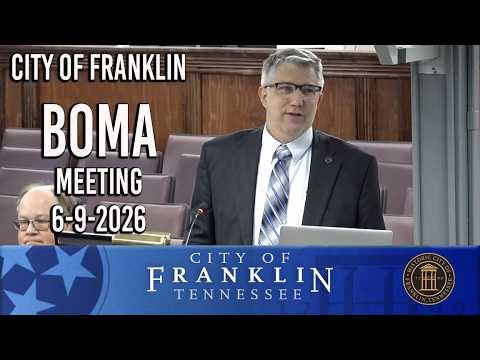
Franklin aldermen unanimously adopted the fiscal year 2026–27 budget on June 9, approving a $273.4 million all-funds spending plan that includes a $134.3 million general fund, a 10-year capital investment plan of roughly $458 million (primarily transportation projects), and targeted operating changes including seven net new positions.
City finance staff presented a final FY2025–26 amendment (Ordinance 2026-09) and the FY2026–27 budget (Ordinance 2026-10). The FY26 amendment recognized adjustments across multiple funds — including higher-than-expected local option sales tax receipts, vacancy adjustments, and transfers to finish a land acquisition — and was approved unanimously. For FY27 staff summarized the budget priorities: maintain a low property tax rate (29.6 cents per $100 assessed value), add capacity for capital projects, and fund targeted operational enhancements (police patrol officers, a fire district captain program, grounds positions, and a human-resources organizational-development specialist).
Staff emphasized conservative revenue assumptions while noting stronger-than-expected sales-tax performance to date. The proposed CIP focuses heavily on transportation (about 82 percent of CIP dollars), with the MacHatcher Southeast widening project called out as a major partnership with state funding. Staff said inflationary factors are included in project cost assumptions and that the city is prepared to accelerate projects if funding timing allows.
The board also approved fee and rate changes tied to the budget: a $1 monthly sanitation fee increase in FY27 (with a plan to be self-sustaining), a modest stormwater fee increase phased over several years (about a $2 monthly impact for typical residential customers), and updated plan-review fees for commercial and residential plan review. Officials said these adjustments are intended to make special funds (sanitation, stormwater) self-sufficient over multiyear plans.
Vice Mayor and aldermen asked several questions about inflation assumptions in the CIP, how much is being conserved for projects versus borrowed, and the schedule for major transportation projects. Staff said cost contingencies and timing assumptions were incorporated and that the city has borrowing capacity if projects need to be advanced. Councilmembers also discussed a possible review of fire scheduling models (e.g., 24/72) as a longer-term personnel and operations issue.
Votes and formal action: Ordinance 2026-09 (FY25–26 amendment) and Ordinance 2026-10 (FY26–27 budget adoption) passed unanimously. The board also approved related ordinances and resolutions that implement fee adjustments and adopt a municipal property tax levy (Ordinance 2026-11) and 5-year rate plans for sanitation and stormwater (Resolutions 2026-45 and 2026-46).