Get Full Government Meeting Transcripts, Videos, & Alerts Forever!
Get email alerts on the Supportive Housing Women topic
No spam. Unsubscribe anytime.
Douglas County presenters outline networked supportive-housing plan for women, cite unit shortfalls and funding gaps
Summary
County staff and nonprofit partners presented a network model to expand supportive housing for women in Douglas County, highlighting strengths (local funding and partnerships), current unit counts at Cardinal and DECA, gaps in services and data, and options to accelerate scale-up including master leases and collective grant applications.
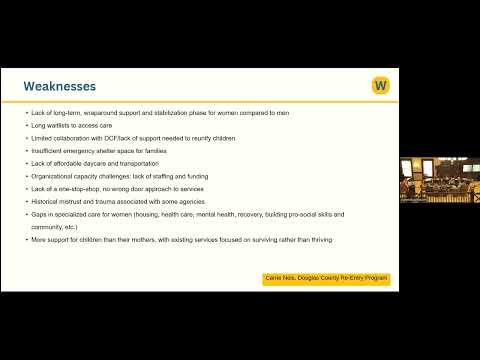
Douglas County commissioners heard a detailed briefing on June 10 about a proposed networked approach to supportive housing for women, including a SWAT analysis, a theory-of-change model and partner roles to increase capacity and coordinate care.
"We're here today to present ... supportive housing for women in Douglas County and a network approach to maximizing resources and coordinating care," said Jill Jolliker, who led the session. Presenters said the effort is tied to the county strategic plan "A Place for Everyone" and aims to address higher local rates of homelessness among women.
Presenters from Cardinal Housing Network, DECA, Amethyst Place, Family Promise of Lawrence, STA Care Center and re-entry services described a multi-partner model in which housing providers, stabilization supports, health centers, treatment partners and therapeutic services share responsibility for referrals and on-site care. "We are averaging one contact a day per individual living there," said Carrie Nice, the re-entry director at the county jail, describing the case-management touch points Cardinal and partners provide to residents.
Commissioners pressed presenters for concrete capacity figures. Hannah Bolton of Cardinal stated, "we have all three apartments filled at 1128 Ohio," and said some program numbers varied by site: "It was originally 10. Nine is a much better number... Eight's a great number for Next Door." In discussion the group also identified five Oxford homes (two eligible for mothers) and characterized roughly 15 beds called out in the exchange; DECA staff said the DECA campus can hold up to about 20 people. Presenters promised to follow up with a coordinated inventory, saying a reliable snapshot can be drawn from coordinated entry/HMIS data and the 2022 needs assessment.
Speakers emphasized program design choices that affect outcomes. Cardinal's current structure asks residents to begin paying rent after about 30 days, which partners said can undermine savings and transitions to independent housing. By contrast, Sarah Nafomalong of Amethyst Place described a model in Kansas City that subsidizes rent for the first six months under state vouchers to allow residents to stabilize and save: "At Amethyst Place, they don't pay rent for the first six months."
Presenters flagged key threats to scale-up: competition for a limited pool of philanthropic and governmental funding, staffing shortages (noting long waitlists for therapists), permitting delays for new housing, and stigma toward people in recovery. Zach of the sexual trauma abuse care center highlighted a local equity concern, reporting shelter data that "almost 10% of new guests were Native American or indigenous folks," compared with a much smaller indigenous share of the underlying population in Lawrence, and urged attention to culturally appropriate outreach and partnerships.
On funding and rapid scale-up, presenters recommended a suite of tactical approaches: collective grant applications to pursue state and federal funding, the county serving as a grant-holder or backbone administrator, use of flex vouchers for pilot units, and creative options such as master-leasing a building to speed occupancy without immediate capital purchases. Sarah and other presenters said Amethyst Place has shared clinical materials and operational templates to accelerate implementation locally.
Panelists also outlined practical barriers and solutions for people leaving custody: staff can secure birth certificates and Social Security documentation while someone is incarcerated and can accompany people to get IDs after release, but out-of-state births and agency backlogs can delay ID issuance. Re-entry staff described flexible voucher arrangements that can include case-management support for up to 24 months in some arrangements.
Commissioners and presenters closed by noting next steps: presenters will follow up with precise unit counts and coordinated-entry data, and the briefing will inform budget and grant strategies. The work session recessed until the 5:30 p.m. business meeting.