Get Full Government Meeting Transcripts, Videos, & Alerts Forever!
Get email alerts on the Municipal Budget topic
No spam. Unsubscribe anytime.
Agoura Hills reviews midcycle budget; staff projects $19.7 million in revenue for FY 2026–27
Summary
City staff presented a midcycle review showing a proposed FY 2026–27 general fund of $19.7 million in revenues and expenditures, reflecting an 8.3% overall revenue reduction and department-level cuts; council discussed reserves, special funds and revenue risks before approving staff direction to finalize the draft.
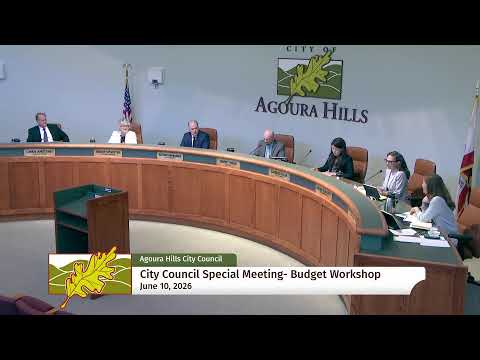
City Manager Nathan Hamburger and Finance Director Diego Ananos presented the Agoura Hills midcycle biannual budget review for fiscal year 2026–27, telling the City Council the draft general fund would show $19.7 million in revenues and $19.7 million in expenditures.
Diego Ananos said the updated forecast reflects an 8.3% overall revenue decrease driven by lower sales and use tax and slowed development activity. "For the updated proposed year, we have to reduced our taxes ... to 16.5 million," Ananos said, and he noted sales and use tax was revised from $4.7 million to $4.4 million, a 7.1% reduction. He also reported building permit revenue moved from $500,000 to $450,000 and planning fees from $383,000 to $180,000, while projected investment income increased.
The presentation identified expenditure changes tied to contractual and personnel costs. Staff included a 3.2% cost-of-living increase adopted last year, changes to employer retirement contributions, and a 2.3% increase in the public safety line for the sheriff contract. Ananos said some departmental cost reductions (communications, automated services and non-departmental salary savings) and one-time items from the prior year—most notably a previous $50,000 council goal for home hardening—lowered FY 2026–27 spending needs.
Staff also described the city's other fiscal tools. The finance director said Agoura Hills manages 28 special funds (gas tax, traffic safety, Measure R, Measure M and a new Council of Governments fiber-optic fund) and is budgeting a capital improvement program of about $19.1 million for 2026–27. He reported city reserves remain robust—near $13 million—and told the council staff intends to avoid drawing on reserves in the planned draft while continuing to pursue grant funding and a five-year forecasting model.
Council members thanked staff for the work and flagged revenue risk from regional events and economic shifts. Council Member Sylvester noted a proposal to consider increasing the pool available for community grants in future budget cycles to account for inflation and demand. Mayor Wolf said staff will return a finalized budget for possible adoption at the June 24 meeting.
The workshop proceeded without public comment and concluded with staff directed to incorporate the council's guidance into a revised draft budget and community grant awards.