Get Full Government Meeting Transcripts, Videos, & Alerts Forever!
Get email alerts on the Basalt Creek Master Plan topic
No spam. Unsubscribe anytime.
Wilsonville planners begin five-month review of Basalt Creek master plan, press for transportation and infrastructure clarity
Summary
Planning commissioners reviewed a draft Basalt Creek master plan that frames one of Wilsonville’s largest employment opportunity areas. Staff and consultants focused on land-use districts, natural resources, phased infrastructure and a transportation analysis; commissioners asked for detailed modeling, railroad coordination and funding options.
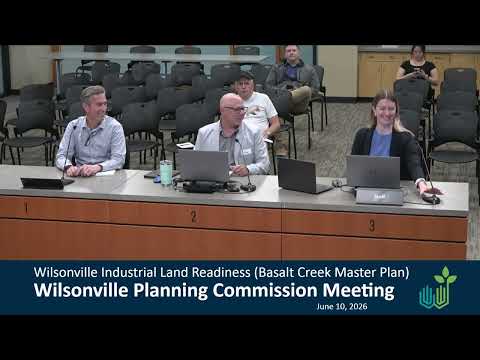
The Wilsonville Planning Commission on June 10 began a five-month review of the Basalt Creek master plan, a multi-year effort to shape one of the city’s largest remaining employment areas. City staff said the meeting launches a formal adoption process that will include a second work session on July 8, a City Council work session on Aug. 3 and a public hearing before the commission on Sept. 9.
The draft plan, presented by city staff and consultants from MIG and DKS, proposes a layered approach: updated natural‑resource protections, district-scale land‑use guidance for high‑tech, light and craft industrial areas and a transportation concept aimed at supporting long‑term employment growth. "It's a pretty cool night for us in the planning department," said Chris, the staff presenter, framing the discussion as a milestone in a process that has run for more than two years.
Why it matters: Basalt Creek sits within the Portland metropolitan employment region and represents a major opportunity to coordinate development, infrastructure and environmental stewardship before large-scale construction starts. The draft ties new land‑use guidance to technical appendices covering water, sewer and stormwater and lays out three phasing buckets — near‑term planning and policy, medium‑term infrastructure planning and funding, and long‑term buildout — to sequence investments.
What was proposed and discussed
Document structure and appendices: Consultant Lauren Scott (MIG) walked commissioners through chapters that summarize technical studies, economic conditions and a land‑use framework. A natural‑resource inventory identifies wetlands, riparian corridors and habitat areas that will constrain some development footprints and shape road and trail alignments.
Districts and expectations: The plan refines the 2019 concept plan into districts intended to support different employment types — high‑tech employment, light industrial, craft industrial and West Railroad — with development expectations tied to site characteristics, market conditions and infrastructure availability.
Transportation analysis: Jenna from DKS summarized the transportation work, which assessed roadway, freight, bicycle, pedestrian and trail needs for growth assumptions up to 20 years. She told commissioners that the plan relies on projects already in the regional Transportation System Plan and that those projects will likely be needed to serve employment growth. "If you build these improvements, traffic will come," Jenna said, but added that current modeling shows the identified network would support the planned buildout and that partners (Wilsonville, Tualatin, Washington County and Metro) are tracking improvements and funding.
Rail access and constraints: Staff said West Railroad can be served by two access points — Tonquin/Tonkan Road to the north and Grahams Ferry Road to the south — without a new public railroad crossing, though a Cahalen crossing could improve connectivity if negotiated. Commissioners pressed staff on the timing and cost of a southern undercrossing; staff characterized that project as long‑term and likely requiring dedicated city investment and potentially urban‑renewal financing.
Coordination and documentation requests: Planning Director Miranda said the concept planning, transportation refinement plan and comp‑plan amendments were developed in close partnership with neighboring jurisdictions (Tualatin and others), and staff agreed to provide earlier planning documents and to have engineering consultants attend the next work session for a deeper dive on infrastructure sizing and downstream impacts. Miranda noted that the Basalt Creek transportation refinement plan (2014) and subsequent South County infrastructure work were important background documents that staff can share.
Public comment and task‑force input: Cynthia Russell, a member of the building‑height waiver task force, thanked staff and said she was "excited to see your guys' discussion and where it goes with it." Commissioners reiterated concerns about fragmented ownership, the need for proactive city land‑assembly strategies and the role urban renewal might play in funding infrastructure.
Next steps: Staff will return July 8 with draft code amendments and technical appendices (stormwater, sanitary sewer, water), and the commission will review transportation and infrastructure detail at that time. The packet schedules an Aug. 3 Council work session and a Sept. 9 Planning Commission public hearing as the next formal milestones.
The commission did not take formal action at the June 10 work session; staff said subsequent sessions will include more technical detail and a refined implementation and funding picture.