Get Full Government Meeting Transcripts, Videos, & Alerts Forever!
Get email alerts on the Homestead Tax Credit topic
No spam. Unsubscribe anytime.
Committee advances raising homestead tax credit cap to 5% paired with phased property tax cuts
Summary
The Budget & Appropriations Committee voted to send Council Bill 26-0151 to second reader after members approved an amendment raising the homestead tax credit cap from 4% to 5% and pairing it with a two-year, five-cent residential property tax-rate reduction the administration says will bring rates below $2 per $100 by fiscal 2028.
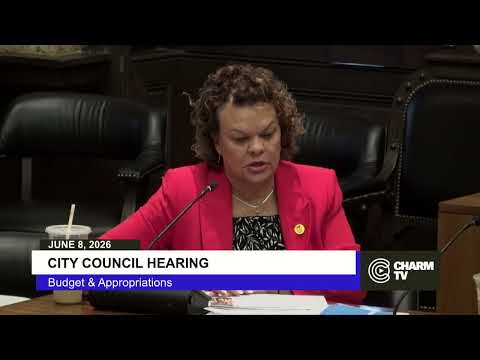
The Baltimore City Council Budget and Appropriations Committee on June 8 voted to move Council Bill 26-0151 to second reader after approving an amendment that raises the homestead tax credit cap from 4% to 5% and pairs that change with a phased residential property tax-rate reduction the administration says will lower the rate below $2 per $100 by fiscal 2028.
Vice President Sharon Green Middleton, the bill sponsor on behalf of the administration, told the committee the package is intended to provide meaningful relief to homeowners while protecting core city services. “This proposal strikes the right balance,” Middleton said, asking members for a favorable report. Desire Lucky of the law department told the committee the amendment raises no legal issue, noting state law limits some changes to 1 percentage point at a time.
Bob Santa, deputy director in the Department of Finance, described a revised 10-year plan that pairs a 5% homestead cap with a phased rate cut: a 1-cent residential-rate reduction in the current fiscal year followed by a 4-cent reduction next year to total a five-cent cut over two years. Santa said the scenarios the department ran show the majority of homeowners would benefit over multiple assessment cycles and that the approach preserves long-term budget sustainability.
Christopher Bernett, director of community affairs, outlined an outreach and enrollment strategy to make sure eligible residents can access the homestead and related credits. Bernett said the city estimates about 99,851 households are eligible for the homestead credit and that roughly 25,000 have already enrolled; the administration will use mailers, door-knocking, CAP center coordination and a new dashboard to track enrollments by council district and block.
Several council members pressed the administration for more granular data. Councilman Isaac Gizy Slifer said he has identified individual long-term homeowners who could see higher tax bills under the change and asked the administration to provide an address-by-address analysis before a final vote. Santa said the finance team can provide current-address data and modeling scenarios to show impacts on individual properties but cautioned that some outcomes depend on future assessment growth.
Slifer also sought stronger immediate relief for taxpayers, arguing the city should implement a two-cent reduction this year per the original 10-year plan rather than the administration’s one-cent start. Finance officials replied that the revenue backing a two-cent cut is not available in the current fiscal year and that the administration’s plan reaches the same five-cent total over two years.
Councilman Slifer offered a separate amendment to add a sunset and require the council to reauthorize the 5% cap if future administrations do not follow through on further rate reductions. The committee voted to report the bill as amended. The recorded roll call included McCrae (yes), Slifer (no, who explained his vote), Middleton (yes) and Gray (yes); one member, Councilman Glover, was excused. The committee approved the bill by a 3–1 margin with one excused absence and ordered it to second reader at the full City Council meeting.
The committee adjourned after the vote. The bill will proceed to the City Council’s second reader on the date announced by the clerk.