Get Full Government Meeting Transcripts, Videos, & Alerts Forever!
Get email alerts on the Transportation Safety topic
No spam. Unsubscribe anytime.
Waxhaw task force advances draft Safety Action Plan, endorses Vision Zero targets
Summary
At its fourth task force meeting, Waxhaw consultants reviewed the high‑injury network and project prioritization method, the group approved swapping multimodal and vehicular design weights for prioritization, endorsed an aspirational Vision Zero target for the draft plan, and set a public review and adoption schedule.
The Town of Waxhaw Safety Task Force met for its fourth and final scheduled working session to prep a draft Safety Action Plan required for SS4A grant eligibility. Consultants from Kimley‑Horn walked the group through the town’s high‑injury network, the method used to turn that analysis into planning‑level projects, a five‑category prioritization framework, and a draft Vision Zero commitment for inclusion in the plan.
The consultants described how they build the high‑injury network (HIN) by scoring roadway segments using fatal and severe‑injury crashes, general crash counts and bike/ped crash history. They said the HIN guided creation of a planning‑level project inventory by overlaying known local, regional and state projects and then inserting project lines where gaps remained. The consultant gave Millbridge and several downtown locations as examples of uncovered segments where new sidewalk or intersection projects were created.
On prioritization, the task force reviewed five weighted categories—connectivity, multimodal design, vehicular design, implementation/funding impacts and community context (which includes a small bonus for projects helping Hillrest). A committee member moved to swap the multimodal and vehicular design weights so pedestrian and bicycle considerations would carry greater weight in the draft scoring; the motion was seconded and carried with no objections.
The group also debated a draft Vision Zero commitment required for the SS4A application. The draft read that the town would seek to eliminate all fatal crashes, achieve a 50% reduction in severe‑injury crashes by 2035 and, by 2045, commit to reducing all fatal and severe‑injury crashes. Consultant Natt Hayward read the draft target to the group: “the town of Waxhaw would commit to reducing all fatal crashes, additionally, a 50% reduction in severe injury crashes by 2035, and by 2045 we would commit to reducing all fatal and severe injury crashes in the community.” Meeting participants discussed whether to soften or clarify language and whether targets should be absolute or relative; members accepted the aspirational draft language to move forward in the plan, noting the target is still subject to revision during staff review and public comment.
Members asked about specific projects and timelines. On a question about downtown turning‑movement crashes, the consultant reported that the Broom Street roadway improvement project (Church Street to US‑75) is already programmed and includes turn‑lane and median/island options; construction is currently estimated for 2028, with earlier right‑of‑way and design steps still required. The consultant also said some interim, “quick‑build” countermeasures from the FHWA toolbox could be coordinated with NCDOT district staff for DOT‑owned segments while larger projects proceed.
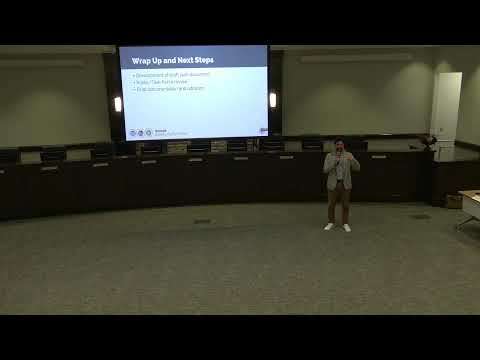
The consultant outlined next steps: the draft plan will be delivered to town staff, made available for task force and public review on September 1 for a two‑week comment period, and the plan is anticipated to be considered for formal adoption at the town board meeting on September 23. Adoption is required for eligibility in a planned SS4A implementation grant round next spring. The consultant recommended the task force consider periodic reconvening after adoption to track progress and update the HIN as conditions change.
Key numbers and clarifications noted in the meeting: the consultant reported roughly 23–24 fatal or severe‑injury (FSI) crashes in the last five years for Waxhaw, with about six or seven of those involving pedestrians or bicyclists (approximate figures discussed during the meeting). The project list will include planning extents, recommended treatments and cost estimates to inform implementation decisions and grant applications.
The task force closed with thanks to the consultant team and staff; the draft plan, public comment window and September adoption target were reiterated as the next steps.