Get Full Government Meeting Transcripts, Videos, & Alerts Forever!
Get email alerts on the Housing topic
No spam. Unsubscribe anytime.
Adams County staff recommend targeted CDBG public‑service awards, defer two HOME capital requests and pause tenant assistance decision
Summary
County staff proposed spending priorities for the 2026 CDBG and HOME allocations, recommending three public‑service grants and the county minor home‑repair program while recommending against underwriting two large HOME development requests; the board directed staff to hold a $1.44M tenant‑based rental assistance request pending state TPV outcomes.
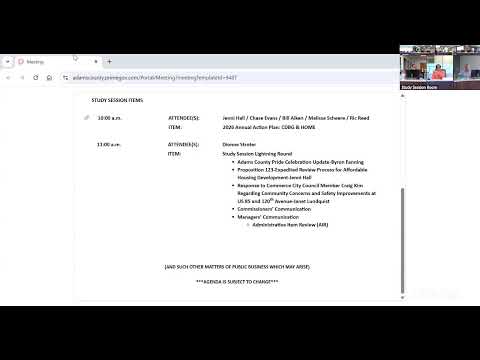
Jenny Hall, Adams County community and economic development director, opened the study session with a review of the county’s role in administering federal Community Development Block Grant (CDBG) and HOME Consortium funding for the urban county jurisdictions.
Staff said HUD’s 2026 award to the urban county and HOME consortium is approximately $1.237 million in CDBG and about $1.1 million in HOME funds. Rick Reid, with the county housing policy and community investments team, outlined required set‑asides: up to 20% for administration and a 15% cap on CDBG public‑service funding; the staff recommendation used the full administrative set‑aside ($247,000) and left $185,619 available for public services.
On public‑service awards, staff recommended funding three applicants: Intervention, Inc. (domestic violence/homeless prevention) at $75,000; Angel Heart (home‑delivered meals for seriously ill, food‑insecure residents) at $75,000; and Colorado Legal Services’ ID Opportunity Project at $35,619 (the remaining public‑service cap). Melissa Sherry told commissioners these organizations have prior CDBG or CDBG‑CV awards and meet eligibility and underwriting criteria.
Staff also explained why three other public‑service applications were not recommended: insufficient nonprofit formation or governance documentation, missing a federal Unique Entity Identifier (UEI), and unclear low‑ and moderate‑income (LMI) beneficiary documentation. "If they are interested in future CDBG funding, we'll work with them on meeting eligibility," Sherry said.
On HOME funds, staff declined to recommend two proposed capital projects because they failed HOME underwriting requirements. Brighton Housing Authority’s Adams Point ($800,000 request) and North Point Development’s project (listed in an application as Gemini, now Vantage Point) lacked other secured financing such as tax credits, so staff could not underwrite gap funding. "We will continue to work with those sponsors if they secure other capital sources," Melissa Sherry said.
Brighton Housing Authority also requested $1.44 million in tenant‑based rental assistance (TBR) to cover roughly 40 households for up to 24 months as the emergency housing voucher program winds down. Commissioners pressed staff on fairness and long‑term consequences of extending short‑term rental subsidies for households that may have received assistance for multiple years. One commissioner framed the choice as: provide an immediate stopgap for existing households or reserve HOME funds for long‑term affordable housing production.
After discussion the board gave informal consensus direction consistent with staff’s recommendation: do not approve Adams Point or Vantage Point HOME gap funding at this time, and defer action on the TBR request (option 4) while staff and elected leaders wait for clarity on state allocations of tenant protection vouchers (TPVs) and pursue longer‑term housing solutions.
Staff said next steps include posting the 2026 Annual Action Plan for a 30‑day public comment period beginning June 18, returning to the board at a public hearing on July 21 to consider adoption, and submitting the plan to HUD by August 14.
Ending note: commissioners asked staff to continue working with applicants that missed eligibility requirements, to document eligibility checklists publicly, and to return with the IGA and any recommended updates to the urban‑county allocation formula during the next IGA renewal.