Get Full Government Meeting Transcripts, Videos, & Alerts Forever!
Get email alerts on the Fisheries topic
No spam. Unsubscribe anytime.
Trump proclaims reopening of nearly 500,000 square miles of Pacific fishing grounds
Summary
President Donald Trump announced a proclamation reopening almost half a million square miles of U.S. waters in the western Pacific, saying the move will expand domestic harvests, protect coastal jobs and lower seafood prices; industry leaders at the event backed the change and raised concerns about offshore wind impacts.
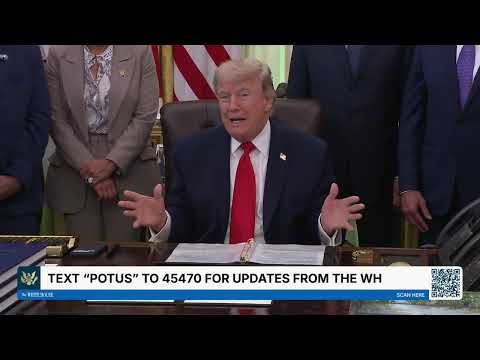
President Donald Trump announced a proclamation reopening "nearly half a million square miles" of U.S. waters in the western Pacific, saying the move will restore commercial access around the northwestern Hawaiian Islands, the Commonwealth of the Northern Mariana Islands and American Samoa.
The president framed the action as a win for coastal communities and domestic seafood production. "America's fishermen have never had a better ally in the White House than Donald Trump," the event transcript records. He said the change will "support millions of dollars in annual harvest" of species including tuna and swordfish and will help lower seafood costs for American consumers.
Why it matters: Officials and industry speakers at the White House said reopening the areas will benefit processors and family-run fisheries that they said were cut off by prior restrictions. Frank Dulich, identified in the remarks as chief executive officer of Pacific Seafood, said his company employs about 3,000 people and said roughly "715 fishing families" in the lower 48 and Alaska depend on access and processing jobs.
Officials and industry also raised conservation and management claims. Administration officials said they plan to "significantly raise catch limits based on the best available science" and to increase gear flexibility; industry representatives said such measures would unlock economic value and protect multigenerational fishing businesses.
At the event, participants pointed to specific closed areas, including a cited 500-by-500–mile Atlantic area and a 248-square-mile section off Georges Bank that speakers said has been closed for decades. One New Bedford scallop industry adviser warned that scallops undergo cycles of maturation and that unused stocks can die off while access is restricted.
Offshore wind raised as a related concern: A questioner asked whether the administration would continue to oppose offshore wind projects near U.S. coasts, arguing turbines can harm fisheries. After President Trump asked "Doug, would you want to answer that question?" an official who spoke in response said construction has "an effect on fisheries" and on marine mammals and described radar and undersea interference concerns. The official also characterized the installations as a national security vulnerability because, he said, they could create radar interference that would complicate detection of low-altitude autonomous threats.
What officials said they would do next: The president said he intended to sign the proclamation and declined to use an "auto pen," emphasizing that the administration is taking direct action. Industry leaders thanked the administration at the event and urged follow-up work on specific closed areas, gear rules and catch limits.
What is not in the record: Officials and speakers repeatedly linked reopened access to job creation and lower prices. The administration asserted economic figures in broad terms ("millions," "tens of millions"), and some specific numeric claims (for example, the 3,000 employees and 715 fishing families cited by Pacific Seafood) were provided by industry speakers during the event and are reported here as stated. No new formal regulatory text or detailed scientific catch-limit proposals were produced in the remarks recorded in the transcript.