Get Full Government Meeting Transcripts, Videos, & Alerts Forever!
Get email alerts on the Expanded Housing Option topic
No spam. Unsubscribe anytime.
Neighbors cite notice and ownership gaps in challenge to six‑unit EHO; BZA affirms permit
Summary
Neighbors appealed an Expanded Housing Option (EHO) permit for a six‑unit building, arguing the permit record lacked written owner authorization after a conveyance; staff said the agent remained the same and the permit “runs with the land.” The Board of Zoning Appeals voted 5–0 to affirm the zoning administrator.
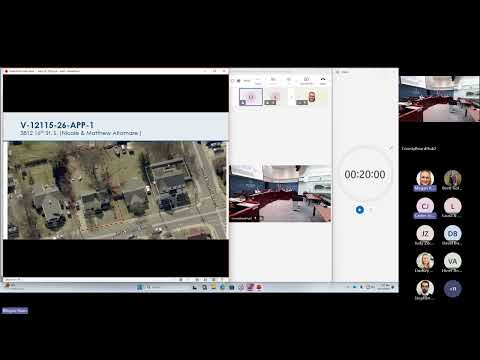
The Arlington Board of Zoning Appeals on June 10 heard neighbors’ appeal of an Expanded Housing Option permit authorizing a six‑unit building on 3812 16th Street South and unanimously upheld the zoning administrator’s decision.
The appeal focused narrowly on an ownership/notice discrepancy in the permit file. Appellants said the EHO permit listed Pacific Homes LLC as the applicant while the county’s conveyance records showed new owners had acquired the lot November 8, 2024. The neighbors said the file lacked documentary evidence that the architect who submitted the application was expressly authorized, in writing, to act for the owners who held title during the staff review, as required by Va. Code § 15.2‑2204(H) in circumstances where an applicant is not the owner. “We ask only that the staff confirm on the record that the file contains documentation of the applicant’s authority to act for the actual owners,” one appellant told the BZA, urging the board to ensure the presumption of correctness attaches to a properly documented administrative decision.
County staff, including the zoning administrator, called attention to the procedural history: the EHO application was initiated in August 2024, paused after a court ruling, and then resumed after a Court of Appeals reversal in September 2025. Staff said the project meets EHO technical standards — reduced parking near transit, gross floor area within EHO limits, and site plans showing three off‑street spaces for a six‑unit building — and maintained that the same architect acted as agent for both the prior and current owner during the review. “The permit runs with the land, not with an individual owner,” Ann Goldsky of the County Attorney’s office told the board, describing staff’s position that agent status and timing of notice, as represented in the file, satisfied the statutory requirement.
Appellants pressed a narrower legal point: an administrative presumption of correctness attaches only to determinations appearing in the record; if the documentary evidence of an agent‑authorization or the alternative written notice to the then‑owner within 10 days is missing, appellants argued, there is nothing in the record to presume correct. Neighbors also raised policy complaints — parking and proximity to transit, notice to adjacent property owners, and appeal fees — but explicitly said those broader questions were for the County Board and not for the BZA in the appeal.
Pacific Homes’ owner, Suresh Bernham, told the board he was aware of and had authorized the EHO application, and the current owners also testified at the hearing that they had authorized the architect to act on their behalf. Staff said it relied on the original application form and the continuing representation by the architect across ownership changes and that there is no county rule requiring a new signed authorization each time ownership transfers between a project’s early filing and its later approval.
After questions and discussion about whether additional documentary evidence existed in the file, a motion to uphold the zoning administrator’s decision was made (motion by Member McCauski; seconded by Member Freshman). The board voted 5–0 to affirm the approval of the EHO permit.
The appellants preserved their factual concerns for the record and noted they may pursue other venues; the BZA’s action affirms staff’s administrative review. Under state law, an appeal from the BZA’s decision would go to the circuit court.
What happened next: staff moved to the next agenda item; the BZA proceeded through several other use‑ and variance‑related matters.